
Making Sense of Your Birth: A Neuro-Affirming Birth Debrief
There is no right way to arrive here.
A birth debrief is a 90-minute, trauma-informed conversation that helps you make sense of what happened during your birth and why it is still with you.
There is no right way to arrive here. You don't need your notes, a clear timeline, or certainty that what you experienced "counts." You just need to feel that something is still unresolved, and be ready to have one honest conversation about it.
Whether your birth was last month or several years ago, if it's still with you, this space is for you.
90 minutes · €135 · online or in Eindhoven
What Is a Birth Debrief?
A birth debrief is a structured, gentle conversation that helps you make sense of what happened during your birth and why, at your own pace, without judgement.
It's designed to help you talk through your experience, share your feelings, ask questions, and explore how the birth may have impacted you, in a safe space, free of judgement or pressure to feel a certain way.
People seek a debrief after all kinds of births: planned or unplanned, medical or physiological, straightforward or with induction. What matters isn’t how the birth “looked” on paper, but how it felt to you.
These sessions can help bring clarity, reduce lingering distress, restore your sense of agency and support emotional integration after birth.
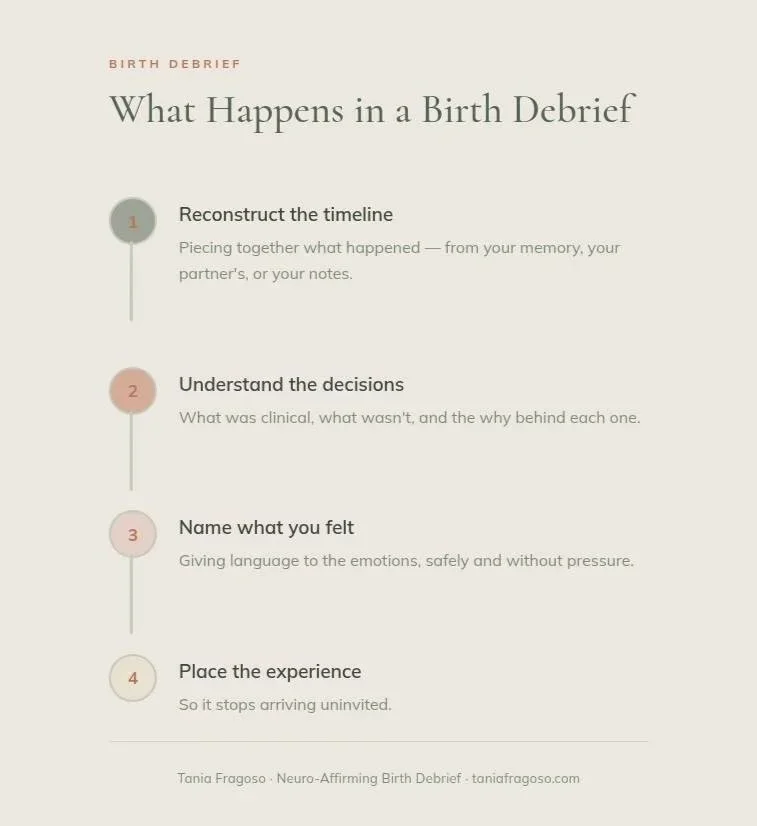
What Happens in a Birth Debrief Session
Over our 90 minutes together, we walk back through your childbirth story, make sense of the decisions that were made, and name what you felt, so it stops replaying on a loop.
Some of the topics we cover
✅Reconstructing the timeline of what happened
From your own recollection of the events, or from the recount of anyone who bore witness to your story, such as your partner or a family member, or your birth notes from the hospital if you have them
✅Understanding what was clinical and what was not
We explore the 5 P's of the labour process *(Passenger, Passage, Powers, Position, and Psyche), helping you find the logic and "the why" behind your experience.
✅Naming what you felt at each point
The safety of a supported and structured session often allows deeper reflections and naming of emotions.
✅Placing the experience so it stops arriving uninvited
Through a trauma-informed approach, the experience can be processed in a pace that keeps you safe
Who Is a Birth Debrief For?
A birth debrief is for any mother whose birth is still with her. It does not matter whether it was six weeks ago or six years ago, whether anything went medically wrong, or whether you would use the word trauma about it.
✅You feel emotionally stuck:
You feel upset, unsettled, or distressed following your birth experience.
✅Your memories feel fragmented:
Parts of your birth feel confusing, hard to talk about, or incomplete.
✅You are replaying moments:
You find yourself stuck replaying intense moments from your birth in your mind.
✅You aren't sure if it’s "trauma":
You are questioning whether your experience "counts" or if your feelings are valid.
✅You had a complex delivery:
You experienced an assisted birth, emergency C-section, severe tearing, or difficulties with pain management.
✅You have experienced baby loss:
You need a supportive, trauma-aware space to process your journey.
✅You are planning your next steps:
You need to reflect and understand your first birth before considering a future pregnancy.
Note: You do not need a medical diagnosis, medical records, or a perfect narrative to begin. If your birth experience is still "living" in your body or your thoughts, this space is here for you.
Emotional Support After Birth for Neurodivergent Mothers
These sessions offer a structured, paced space where you can make sense of your birth experience with someone who understands both perinatal trauma and the neurodivergent nervous system.
The postnatal period can bring a flood of sensory input, unanswered questions, and feelings that are hard to put into words, especially when your brain processes the world differently.
Whether you're navigating ADHD, autism, or birth trauma, or all three at once, this is a space of genuine respect and no pressure to perform recovery. We work slowly and in manageable pieces, always at your pace, with your nervous system's safety as the priority.
If you need breaks, a slower rhythm, or specific adjustments, just ask. This is your space to reflect, and it adapts to you, not the other way around.
What Are The Potential Benefits?
A debrief can close the open loops your mind keeps circling, restore your sense of agency, and help your partner understand what you went through.
I combine my background as a Doula and Counsellor to provide support that is validating rather than just clinical. We don’t just "talk about" the birth; we honour the uniqueness of your nervous system.
Other potential benefits may include:
✅ Close the 'Open Loops': Understand the medical reasoning behind decisions to help soothe the ADHD "need to know."
✅ Sensory-Safe Processing: A pace that respects your communication style, whether you need deep detail or extra time to find the right words.
✅ Reclaim Your Agency: Sometimes, the lack of consent during labour and birth can lead to feelings of loss of agency. You can take back ownership of your narrative and move forward with autonomy.
✅ Partner Support: Enhance connection by helping your birth partner understand the physiological and emotional reality of your journey.
✅ Identify Triggers: We look at what created excessive pain in labour, whether an obstetric emergency happened during delivery, if you suffered a birth injury originating from a shoulder dystocia or postpartum haemorrhage, or whether the anguish was physical, environmental, related to obstetric violence, or caused by a lack of accommodation to your specific needs.
✅ Addressing your internal landscape: We look at the birth from a holistic perspective and talk through what happened to help you process the trauma response. A mother may feel their birth was traumatic without having experienced any of these things, and those feelings are equally valid.
What does the research say about birth debriefs?
The strongest evidence supports birth debriefing as a relational, trauma‑informed conversation that helps many women feel heard, understand their birth, and begin to integrate the experience
✅ Women strongly want and value debriefing service.
A large Australian study of 2,514 mothers found that 80% wanted to talk about their birth, yet only 26% had one. Women described it as important, helpful, and something that should be standard postnatal care.
✅ The main benefits are feeling heard, understood, and informed.
In several qualitative and mixed‑methods studies, women say the most helpful parts are: having their story listened to without dismissal, support and information that allows them to finally understand what happened and why decisions were made in labour.
Concept analysis of midwife‑led debriefing
ECU pilot on midwife‑led birth debrief
✅ Debriefing helps many women process emotions and find meaning.
A 2025 concept analysis of midwife‑led birth debriefing (20 studies) defines it as a woman‑led, emotionally safe conversation that helps women reflect on and make sense of their birth experiences.
Midwife-led birth debrief: concept analysis
✅ It can improve perceptions of birth, especially when it is person‑centred.
A recent study of 273 mothers found that it notably improved labour perceptions for women without reported trauma, and highlighted the need for trauma‑informed, choice‑based approaches for those who did experience birth trauma. Writing‑based reflections also emerged as a helpful alternative or complement.
Perceptions of birth and wellbeing after debriefing
What are the signs and symptoms of birth trauma or PTSD after birth?
Birth trauma doesn't always look the way people expect. You might have been told your birth was "fine", and still find yourself reliving it. Common signs include flashbacks, nightmares, or intrusive memories; avoiding anything that reminds you of the birth; emotional numbness or feeling detached from your baby or partner; persistent anxiety or panic attacks; sleep difficulties, hypervigilance, or being easily startled; and physical symptoms like a racing heart or nausea triggered by reminders of the birth.
Symptoms can appear days after birth or surface weeks later. If they're lasting, getting in the way of daily life, or causing you significant anguish, that's worth taking seriously, not a sign you're overreacting. If you're having thoughts of harming yourself, please talk to your midwife, GP, specialist mental health professional or a crisis line as a priority.
A birth debrief isn't a substitute for clinical care, but it can be a gentle first space to feel genuinely heard, get support and begin making sense of what happened.
My Training & Approach
My approach to perinatal care is built on four pillars: Person-Centred, Neuro-Inclusive Care, Coaching, & Cultural Sensitivity. As a qualified Counsellor (Academie voor Coaching en Counselling), I combine clinical insight with my specialised BIA Doula Training (Amsterdam, 2018).
My practice is deeply inclusive and was born out of my own lived experience. Having navigated maternity care and early parenting in Portugal, the UK, Spain, and the Netherlands, I understand the systemic challenges many parents face when standard healthcare providers overlook their emotional and sensory needs.
I have spent years refining a toolkit to help neurodivergent mothers and survivors navigate the parenting journey, with a focus on perinatal mental health and birth. My training in 3 Steps Rewind for birth trauma resolution and Supporting Neurodiverse Birth (UK, 2024) allows me to help you understand and process your birth story in a safe and inclusive space.
I practise in accordance with my Ethical Commitment & Professional Standards, which cover confidentiality, consent, safeguarding, and ongoing supervision.
What's Included & Investment
A 90-minute session is €135 and includes an intake review before we meet, a personalised integration guide within 48 hours, and a week of follow-up support.
This session is more than a retelling of events; it is a dedicated process of reclamation and integration. This investment reflects the specialised, trauma-aware care required to safely navigate these narratives.
Cancellation policy:
As a specialised professional, I dedicate significant time to reviewing your intake and any notes you might have shared and preparing for our session in advance. While I fully understand that life with a baby can change at a moment’s notice, I would also like to request a 24h notice for cancellation.
What your investment includes:
Pre-Session Intent Review: I personally review your intake forms and any birth notes you choose to share to ensure our time together is focused and supportive.
90-Minute Dedicated Session: A deep-dive exploration using a neuro-affirming and trauma-aware lens, allowing space for pauses, grounding, and emotional safety.
Specialised Expertise: Access to a practitioner trained in 3 Steps Rewind, Counselling, and Physiological Birth (Doula).
Integration Guide: Within 48 hours of our session, you will receive a personalised summary including grounding tools and resources tailored to your specific processing needs.
Support Bridge: One week of follow-up support via my portal to answer questions as your story continues to settle.



Testimonial
"After my twin birth, I felt stuck in the 'what ifs.' Tania's birth debrief helped me finally make sense of my medical notes without feeling overwhelmed."
— Sarah —
⭐⭐⭐⭐⭐
Why This Service Exists
This service exists because I needed it and couldn't find it. If your birth is still with you, this space is here.
My twins were born in 2010 in Portugal. I was 29, and although I am Portuguese, I had been living in London and had been followed there through most of my pregnancy. When the time came, I gave birth in a country I knew, but in a medical system I didn't, with none of the preparation, the language of consent, or the relational continuity I had been building in the UK.
What happened in that theatre took me seven years to begin to understand.
I didn't have a word for what I was carrying. I only knew that something in me had been left behind in that room, and that no amount of gratitude for my healthy babies made it less true.
The AuDHD diagnosis came later. It gave me the framework I had been missing: why the sensory experience of that birth had overwhelmed my system so completely, why my brain kept returning to it, why I couldn't simply file it away and continue.
If you are reading this page, you may recognise something of that. A birth that is still with you. Questions that were never answered. A body that hasn't fully arrived in the present yet.
I built this service from that place. Not from theory, though the training matters, and it's thorough, but from knowing what it is to need a space like this and not be able to find one.
Birth Debriefing for English and Portuguese Speakers worldwide.
90 minutes · €135
Frequently Asked Questions
Questions that address the most frequent questions I receive about this service
-
It is important to ask: "Should I have a birth debrief to help process my birth?" Most find it helpful to better understand, reflect and find closure; however, this is not a medical intervention. It is, as described by third-party resources, a supportive and reflective process to find closure after a difficult childbirth experience.
After a traumatic birth, this session may help, but it must be done with the right person.
It is important to take into consideration that although it might help you to understand what happened, this process is often really hard for those who feel their birth was a traumatic event, and that can bring up to the surface feelings of guilt, anger, shutdown or even re-traumatisation.
-
While some hospitals offer a "Birth Afterthoughts" service, and Dutch midwifery practices offer a nagesprek, many parents prefer an unbiased approach, with a privately sourced trauma-aware perinatal therapist, to ensure that when they share their birth stories, they aren't "gaslit" by the system that may have caused the anguish in the first place.
-
It is common to feel overwhelmed when revisiting intense life events. This is why my consultations are designed as low-demand, high-safety spaces. We move at your speed, I provide ample opportunity to have questions answered, and you are always encouraged to take breaks. My approach is "bottom-up," meaning we prioritise your nervous system's safety above the need to "finish" the story.
-
While I am a trained Counsellor, this one-off session is a supportive, trauma-informed coaching process. It is not a substitute for psychiatric treatment. I do not provide a diagnosis, but if we identify a need for clinical intervention, I will provide appropriate referral pathways
-
While often one debriefing provides the clarity needed to close specific "loops," many mothers, particularly those navigating neurodivergence or complex matrescence, benefit from ongoing reassurance and guidance to address the sadness and grief that often follow this process. Follow-up appointments are available to deepen your healing and ensure your long-term well-being is supported.
-
Many mothers carry distress from a birth that did not go the way they had hoped, even when there was no obstetric emergency. You don't need to have experienced a difficult birth with a midwife, a medical intervention, or a complication for your feelings to be valid.
A birth may have been confusing, lonely, or frightening in ways that are hard to explain to someone who wasn't there. Some women have questions some years later that they never felt able to ask at the time.
Others feel upset or angry about decisions that were made without their input — about the medical assessments and decision-making process by the professionals involved, or plans made during pregnancy that were abandoned without explanation.
If your labour experience is still affecting you, or if you're concerned it may affect a future pregnancy, you deserve the chance to talk it through with someone who will help you understand what happened and give you the answers you need.
-
The nagesprek with your own verloskundige is a good thing and worth having. It covers what happened clinically: the decisions, the timings, what the notes say. If you have not had one, ask for it.
This is for what comes after that. Why the birth is still with you months later. Why your body reacts when someone brings it up. Why knowing what happened has not settled how it felt.
Some mothers come here having had a nagesprek and found it useful but unfinished. Others found it hard to say what they really felt to the person who was in the room at the time. Both are common, and neither means the nagesprek failed.
-
These sessions are a powerful first step in addressing birth-related, emotionally charged feelings. Parents who feel the emotional anguish is too overwhelming around a baby’s birth may avoid retraumatisation by reassessing whether it would be more appropriate to shift to the 3 Steps Rewind method, a gentle, somatic-based alternative to EMDR with a non-retraumatising approach. This allows us to reduce the heavy emotional "charge" of a memory without requiring you to relive every stressful detail.
By identifying specific triggers and physiological responses, we collaborate to move from a state of "survival mode" toward healing. This integrated approach restores trust in your body and helps you feel more grounded in your daily life. While this service guides reflection and coping, I do not provide a diagnosis and treatment for PTSD - post-traumatic stress disorder; for this, you should contact a psychiatrist.
-
There is no time limit for debriefing. Whether your birth was 6 weeks ago or six years ago, or you are now thinking of having another child and feel ready to understand and come to terms with your previous birth. Many women who may feel their birth was traumatic find that this reflective process, offers reassurance and understanding, and can shift the way they feel about it. It is never too late to find healing.
-
I offer the option of a home visit, here in Eindhoven, as many parents struggle to access assistance in the post-partum period and therefore delay processing the emotional experience of what happened with a trained mental health professional. Alternatively, we can arrange this one-off consultation online.
-
You don’t need to have everything figured out. You can request your maternity notes (in Spain, this is your 'Informe de Parto' you can contact the hospital where you gave birth and request it through the Servicio de Atencion al Paciente from the hospital). If you gave birth with a midwife in the NHS, you can request your maternity records submitting a Subject Access Request (SAR).
-
In the Netherlands, you can request your notes from your verloskundige, whether you were seen by an eerstelijns or tweedelijns midwife.
In the UK, you can request your maternity records from the trust by submitting a Subject Access Request.
In Spain, your notes are the Informe de Parto. You can contact the hospital where you gave birth and request it through the Servicio de Atención al Paciente.
You do not need any of this to book. Your own account of what happened is the more important document.
-
Your story is sacred, and your privacy is my priority. In accordance with GDPR and ethical counselling standards, all information shared during our session—including your birth notes and personal history—is kept strictly confidential and stored on a secure, encrypted platform.
I do not share your data with third parties without your explicit written consent, except in rare cases where there is a legal obligation or a risk of harm to yourself or others. As a graduate of the ACC I share and abide by the same Code of Conduct and Privacy Policy.
-
Yes, and many partners find it genuinely valuable to be part of this process. Your birth partner often carries their own version of what happened, and hearing your experience through a structured, trauma-informed conversation can deepen their understanding of what you went through and what you need now. Partners may also benefit from the chance to discuss your birth openly, particularly if they've been holding their own anguish quietly in order to support you.
It's worth knowing that when both of you are present, the session naturally holds more, two perspectives, two emotional responses, and often questions that neither of you has voiced before. In some cases, this means a single 90-minute session provides everything you both need. In others, particularly where the birth involved complex trauma or where each of you is processing at a different pace, a follow-up session may be helpful to give your individual experience the space it deserves.
If you're unsure whether to include your partner, we can talk it through in your discovery call. There's no wrong answer, what matters is that you feel safe enough to be honest in the room.