AuDHD: Autism and ADHD in Women & Mothers
I am AuDHD. Diagnosed with both autism and ADHD. And becoming a mother was, in many ways, the beginning of finally understanding myself and why I genuinely thought I was falling apart in early motherhood.
Not in the ways people warn you about, the sleep deprivation, the identity shift, the relentlessness of it. I had expected those things. What I hadn't expected was the feeling that my entire nervous system was shorting out. That the noise, the touch, the emotional weight of being needed every minute of every day was not just exhausting, but unbearable in a way I couldn't explain to anyone around me.
After a traumatic birth with my twins, I was diagnosed with major depression and anxiety disorder. At the time, there was no framework for birth trauma in the way we understand it now, no recognition that what I had experienced in the birth room might have left its mark in the same way any other overwhelming, frightening experience would. Birth trauma was not something that was associated with postnatal mothers. It was something that happened to war veterans.
It took me years to fully recover. Years of healing that I now understand were also years of trying to make sense of a nervous system that nobody had ever helped me understand.
When I had my third daughter, things were different. I had already begun to piece together that I might be autistic. I prepared carefully, for my sensory needs, for the unpredictability, for the postpartum period. And it worked. My second postpartum experience was genuinely positive.
But then the bubble burst. And I found myself craving more than being a mother, while simultaneously having no capacity to reach for it. When COVID arrived, I was diagnosed with burnout. And I have since come to understand that burnout, for me, has a shorter and shorter cycle each time it arrives.
I am still learning to hold both sides of myself, the part that craves novelty and action, and the part that desperately needs structure and nervous system regulation.
What is AuDHD?
It is a term used to describe people who are both autistic and have ADHD (Attention Deficit Hyperactivity Disorder). It is not an official clinical diagnosis; it came from the neurodivergent community itself, as a way of naming an experience that clinical language had long struggled to capture.
Until the publication of the Diagnostic and Statistical Manual DSM-5 in 2013, clinicians were not permitted to diagnose a person with both autism spectrum disorder (ASD) and ADHD simultaneously. The assumption was that they were mutually exclusive. We now know this is simply not true.
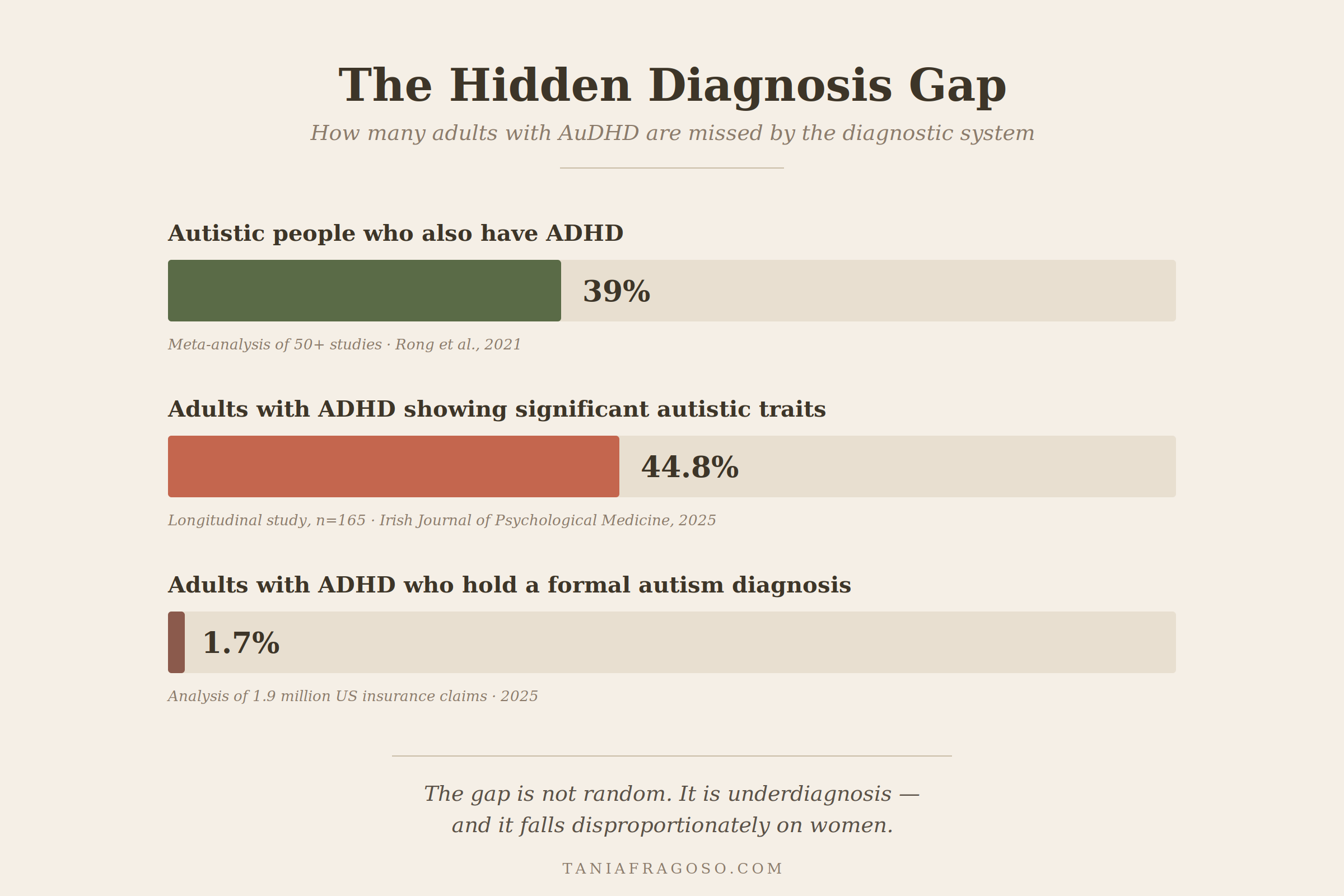
Research tells us that the co-occurrence is both common and widely underrecognised. A meta-analysis of more than 50 studies found that among people with autism, around 39% also had ADHD. A 2025 longitudinal study found that 44.8% of adults with ADHD showed significant symptoms of autism. And yet an analysis of 1.9 million US insurance claims found that only 1.7% of adults with ADHD had a co-existing autism diagnosis, a gap that researchers describe as likely signalling significant underdiagnosis.
A 2025 neuroimaging study added another layer of understanding: people with co-occurring ADHD and autism show distinct patterns of brain structure and connectivity, suggesting that it’s not simply the sum of two conditions, but may represent a unique neurological profile of its own.
How common is AuDHD?
It]s more common than most people realise, and far more commonly missed than the numbers suggest.
The rise of AuDHD as a recognised experience reflects both growing awareness and decades of missed diagnoses. That diagnostic gap is not random. It falls disproportionately on women, on those who spent a lifetime masking both conditions so effectively that even the people closest to them never suspected a thing. The ones who were told they were anxious, or sensitive, or simply not trying hard enough.
Decades spent trying to fit into a world not built for your brain take an enormous toll. One that, for many women, only becomes impossible to ignore when they become a mother.
How autism and ADHD can hide each other
One of the reasons why it’s so frequently missed is that the diagnostic process itself can be complicated by the way each condition masks the other; this is something researchers call diagnostic overshadowing: when one diagnosis explains enough that the other remains invisible.
The writer and educator Megan Anna, who writes about AuDHD from lived experience, describes this beautifully. After her autism diagnosis, she found enormous relief, a framework for the sensory experiences, the fragmented social history, and the way her identity gathered around specific interests. For a while, that felt like enough. It was only when she went deep into ADHD research that she recognised the residue the autism explanation had never quite reached: the bathroom counter that would not stay clean, the ten projects going at once, the overwhelm from basic life tasks, the mind that pinged in several directions the moment she stepped outside a state of hyperfocus.
This is extraordinarily common. Autistic structure — the lists, the routines and schedules, the monotropic depth of focus — can bury ADHD traits in plain sight. Conversely, ADHD's social adaptability can mask autistic traits. Each condition can make the other harder to see, both for the person living it and for the clinicians assessing it.
Research published in 2024 notes that ADHD and autism have historically been considered male conditions, with diagnosis being four times more likely for males than females. Women are far more likely to mask, to learn, often from a very young age, how to camouflage their differences, mirror those around them, and perform neurotypically with exhausting precision. The social challenges this creates go largely unseen, as do the difficulties with social interaction that sit beneath the surface.
This masking comes at a profound cost. It depletes the nervous system. It creates a persistent gap between who you are on the inside and who the world sees. And it makes diagnosis extraordinarily difficult.
Many women find themselves AuDHD diagnosed only after years of being told they had anxiety, depression, or simply needed to try harder. The lack of recognition of their struggles and support by the systems that should have helped is one of the most common threads running through late-diagnosed women's stories.
And then they become mothers.
Why neurodivergent women are at higher risk during the perinatal period
The research here is detailed, and it matters deeply. A 2024 systematic review published in Women and Birth found that neurodivergent individuals — particularly people diagnosed with autism and ADHD — are at a significantly heightened risk of mental health challenges during the perinatal period, including antenatal and postnatal depression, anxiety, and isolation. A study by Pohl found that autistic individuals were significantly more likely to experience depressive episodes in pregnancy and postpartum compared to their non-autistic counterparts (respectively 40% vs. 25%, and 60% vs. 45%). A 2023 study found that ADHD increased the risk of depression in the perinatal period to 16.76% in the ADHD group, compared to 3.29% in the non-ADHD group.
What the research tells us about birth trauma
A 2021 study concluded that autistic women experience unique challenges during childbirth that may contribute to the perception of traumatic birth. Participants often felt belittled, ignored, and uninformed. They found being at the centre of attention negative and hindering. Their concerns were minimised. They were left out of critical communication.
A 2024 study published in PMC reinforced this, finding significant differences in the pregnancy and labour experiences of neurodivergent women — including higher rates of caesarean section, prolonged labour, and lower rates of breastfeeding initiation — and concluded that many of these outcomes are less a function of neurodivergence itself and more a consequence of a healthcare environment ill-adapted to neurodivergent needs.
This is what I lived. A traumatic birth, followed by a diagnosis that named my depression but not my trauma, and no framework for understanding why the clinical environment had felt so overwhelming, so frightening, so impossible to navigate.
Birth trauma in neurodivergent women is not rare. It is underdiagnosed, undernamed, and undertreated.
Can motherhood make AuDHD symptoms worse?
Yes, and there needs to be more awareness about this.
During pregnancy, hormonal shifts significantly affect how both ADHD and autism present. Oestrogen plays a role in dopamine regulation, which is the neurotransmitter responsible for attention, motivation, and emotional regulation. As oestrogen levels fluctuate during pregnancy and drop sharply after birth, many women find that the ADHD symptoms they had previously managed, often through years of carefully constructed coping strategies, become much harder to navigate.
The postpartum period compounds this. The loss of sleep, which is already harder for many neurodivergent people to regulate, compounds everything. The sensory environment of caring for a newborn — the constant touch, the noise, the unpredictability — can trigger sensory overload in ways that are genuinely overwhelming for a neurodivergent nervous system. The loss of structure, organisation and routine, which many autistic people rely on deeply, arrives at precisely the moment when structure feels most impossible to create.
And then, as I know from my own experience, there is the moment the postpartum bubble bursts.
The early weeks can feel manageable when there is help, when the world contracts to the size of a baby and a bedroom, when expectations are low. But as ordinary life reasserts itself, the AuDHD nervous system faces something it is uniquely ill-equipped to manage without support: a completely restructured life, with new demands on executive function, new sensory pressures, new emotional labour, and no map.
For many AuDHD mothers, this is when burnout arrives. Not with a crash, but with a slow depletion — a creeping sense that the gap between what life is asking and what the nervous system can give is widening, and that there is no way to close it.
What are the symptoms of AuDHD? The paradox at the heart of it all
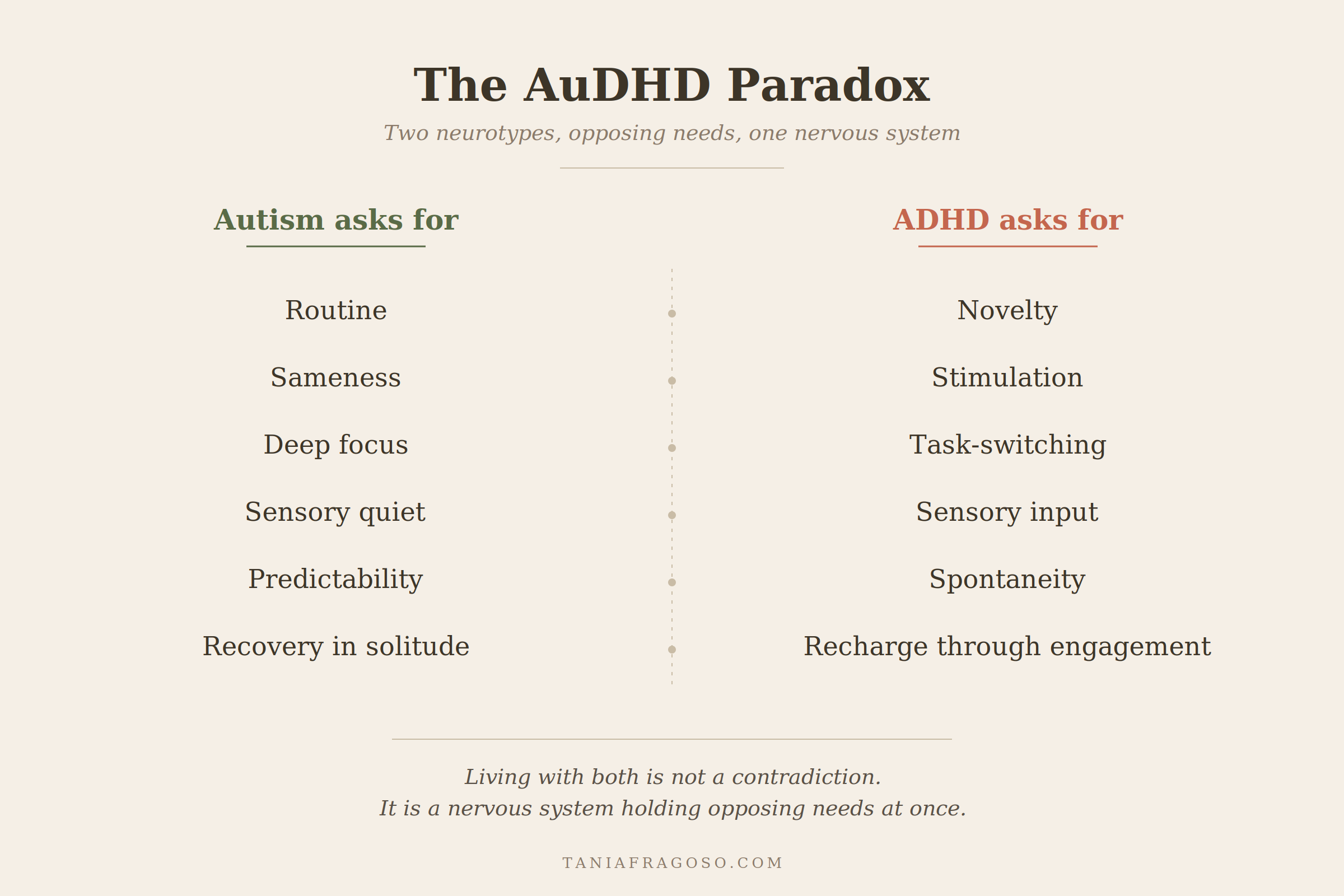
One of the things that makes AuDHD motherhood so specifically exhausting is the tension between the two neurotypes.
The symptoms don't always look the way people expect, particularly in women who have spent years masking them.
The American Psychiatric Association describes some of this clearly: people with ADHD may seek constant stimulation and novelty, while autistic people may be easily overstimulated. A person with AuDHD may find themselves easily overwhelmed but feeling unable to slow down. Struggling between a preference for routines and boredom with sameness. Craving social stimulation but finding it hard to navigate. This creates a set of opposing needs that can feel impossible to reconcile, the nervous system simultaneously craves more and desperately needs less.
This tension does not disappear when a baby arrives. If anything, it intensifies. The chaos that children bring, which is beautiful, alive, and necessary, can feel physically painful to a sensory-sensitive nervous system, while simultaneously feeling like not quite enough stimulation for the part of the brain that craves novelty and engagement.
Impulsivity — acting before thinking, speaking before filtering, making decisions from a place of overwhelm rather than intention — sits in constant tension with the autistic need for structure and sameness. Often considered as a character flaw, is in fact a neurodevelopmental condition interacting with each other in real time. In motherhood, where decisions come relentlessly, and the environment rarely cooperates, this tension can feel exhausting to navigate.
I spent years trying to understand why I was simultaneously desperate for more from life and completely unable to reach for it. The framework was the first thing that made that paradox legible.
Why the standard advice doesn't work
"Sleep when the baby sleeps."
"Just ask for help."
"Lower your standards."
"Every mother finds it hard."
The advice that circulates around matrescence was not written with neurodivergent women in mind. It assumes a nervous system that responds to rest the way most people's do. It assumes that reaching out for help feels straightforward. It assumes that the difficulty is proportional, the same kind of hard, just turned up slightly.
For AuDHD mothers, it is a different kind of hard entirely. And being told to push through, or that everyone struggles, or that you just need to relax, especially when your nervous system is in genuine dysregulation, is not just unhelpful. It can be actively harmful.
The Maternal Mental Health Alliance has noted that women with ADHD are more likely to experience postnatal depression, anxiety, and trauma, yet ADHD is rarely considered in maternal mental health assessments. Perinatal mental health services do not yet systematically screen for neurodivergence. Most standard support was not designed with a neurodivergent nervous system in mind.
What AuDHD mothers need is not generic reassurance. They need the right support — support that understands how their nervous system works, that honours sensory needs, the need for structure and predictability, the tendency towards burnout, and the very specific way that birth and postpartum experience lands in a body that processes the world differently.
What actually helps: a neuro-affirming approach
Neuro-affirming and trauma-informed support starts from a different premise. Not "what is wrong with you?" but "what happened to you, and what does your nervous system need to feel safe?"
It means recognising that burnout in AuDHD mothers is not laziness or lack of resilience. It is the result of a nervous system that has been asked to perform beyond its capacity for too long, without adequate recovery.
It means understanding that birth trauma is more common in neurodivergent women, and that it deserves proper trauma-informed processing, not just reassurance that the baby is healthy.
It means postpartum planning that accounts for sensory needs, executive function challenges, the risk of burnout, and the profound identity shift of matrescence, the process of becoming a mother, which is disorienting for any woman, and particularly so for those who are still learning who they are.
A 2024 systematic review in Women and Birth emphasised the importance of continuity of care in building trust and understanding between healthcare professionals and neurodivergent parents, noting that this continuity is pivotal in creating a supportive environment that genuinely works. Research from PMC in 2024 concluded that what is needed is not a deficit-focused model that pathologises neurodivergent traits, but a genuinely patient-centred framework that anticipates diverse needs and adapts accordingly.
This is not a radical idea. It is simply good care.
The second time was different — because I prepared
My second postpartum experience was genuinely positive, and I want to name why, because it matters. It was not because the second birth was easy, or because I had somehow fixed myself. It was because, going in, I already had a growing awareness of my sensory sensitivities and the possibility that I was autistic. I prepared specifically for my nervous system's needs. I thought carefully about the postpartum environment, about what I would need, about how to structure the early weeks in a way that accounted for how I actually function, not how I thought I should function. That preparation made a measurable difference. This is what neuro-affirming postpartum planning actually looks like in practice. Not a generic birth plan. Not a checklist of tasks. But a genuine, personalised understanding of your nervous system, and a structure built around that understanding.
You are not failing. You are under-supported.
If you are an AuDHD mother reading this, whether you have a formal diagnosis or simply recognise yourself in these words, I want to say this clearly:
The difficulty you are experiencing is real. It is not a character flaw. It is not evidence that you are not cut out for this. It is the entirely predictable result of a system that was not designed for your nervous system, offering support that was not designed for your needs.
For many AuDHD mothers, the experience of feeling misunderstood by healthcare providers, by partners, by the parenting world at large, is one of the most painful parts of the journey.
The gap between what you are carrying and what the world is offering you is real, and it is not your fault.
You deserve care that actually fits you. Support that starts from an understanding of how your brain works, not from an assumption that you should be able to do this the way everyone else does.
That is what I offer. As an AuDHD mother myself, one who has lived birth trauma, burnout, late diagnosis, and the long, ongoing work of learning to accommodate my own nervous system, and as a trauma-informed, neuro-affirming perinatal counsellor, I work with neurodivergent mothers through the full arc of the perinatal experience.
If reading this has put words to something you've been carrying quietly, you don't have to work it out on your own. This is exactly the kind of pattern I help mothers untangle in my perinatal counselling sessions, at whatever pace feels right for your nervous system.
References and further reading
Women and Birth 2024 systematic review: https://www.womenandbirth.org/article/S1871-5192(24)00285-3/fulltext
PMC 2024 — Pregnancy and Childbirth in Neurodivergent Women: https://pmc.ncbi.nlm.nih.gov/articles/PMC12653929/
National Geographic 2025 — How autism and ADHD overlap: https://www.nationalgeographic.com/health/article/what-is-audhd-adhd-autism-overlap-adults
American Psychiatric Association — When Autism and ADHD Occur Together: https://www.psychiatry.org/news-room/apa-blogs/when-autism-and-adhd-occur-together
Maternal Mental Health Alliance — ADHD and perinatal mental health: https://maternalmentalhealthalliance.org/news/adhd-perinatal-mental-health-breaking-silence-neurodivergent-mothers/
Birth Trauma Association — Neurodivergence and birth: https://www.birthtraumaassociation.org/news-campaigns/blog-post-title-four-4jwnw-x3zm9-he23x-4gycw-zr29a-8nx7j-ww4mj
Raising the Voices of AuDHD Women and Girls 2024: https://www.tandfonline.com/doi/full/10.1080/09687599.2023.2299342
Vanderbilt — AuDHD Hidden Dynamics: https://www.vanderbilt.edu/autismandinnovation/audhd-the-hidden-dynamics-of-a-dual-diagnosis/