Navigating Motherhood with RSD: A Neuro-Affirming Guide

Imagine you are six weeks postpartum. A well-meaning family member gently asks, "Is the baby still waking up that often?" To anyone else, it is a simple question. To you, it makes your nervous system go into overdrive — it feels like a physical punch to the stomach. Your throat tightens, your heart drops, heat builds and takes over. Suddenly you aren't just a tired parent; you are a "failure" who cannot even soothe her own child. If that wave feels familiar, you may be experiencing RSD (Rejection Sensitive Dysphoria).
This visceral, overwhelming reaction is often a hallmark of RSD. While not an official diagnosis, it is a term experts use to describe the extreme emotional pain triggered by real or imagined rejection, criticism, or failure. For many neurodivergent mothers, this experience is not a “dramatic overreaction” or a character flaw; it is a physiological reality.
Think of your brain’s emotional regulation as a volume control on a TV. For a neurotypical individual, social feedback is kept at a manageable level. In an ADHD or Autistic neurological wiring, that volume control is often stuck at a painfully high level of emotion. The mind fails to filter the “loudness” of social feedback, causing the nervous system to sound an emergency alarm even when no real danger exists.
This guide is designed to help you work with your highly reactive nervous system, not fix it
What Does RSD Actually Look Like?
It is not just an emotional experience; it is a full-body event. It arrives without warning, often faster than your rational mind can catch up. Here is what it can look and feel like:
In the body: a sudden drop in the stomach, heat flushing to the face, throat tightening, chest heaviness, shaky hands, or a wave of nausea. Your body responds as though a physical threat has arrived because, to your nervous system, it often feels that way.
In the mind: immediate spiralling thoughts, catastrophising, mind-reading ("she thinks I’m a terrible carer"), and a rapid collapse into shame or rage. The nervous system takes over completely, and you might not be able to put a stop to it.
In behaviour: withdrawing suddenly, feeling dysregulated and lashing out in protective anger, over-explaining yourself, going very quiet, or leaving the room. Some parents freeze entirely. Others mask brilliantly and then fall apart in private.
After the episode: exhaustion, shame about the reaction itself, and often a negative voice that keeps you ruminating for hours or days. The ADHD neurology hyperfocus locks onto the event and will not easily let it go.
In early motherhood, a single comment can set this off. “Is the baby still not sleeping through?” “Are you sure you have enough milk?” “She seems unsettled.” To someone without the intense fear of rejection, these are passing observations. To a mom with adhd or autism that has a sensitised nervous system, they can feel like a verdict.
What Activates RSD in Motherhood?
They are not always obvious and are rarely the big, dramatic moments. They are often small, ambiguous, everyday interactions that the sensitised mind interprets as rejection or failure. Common triggers for parents include:
Unsolicited parenting advice — from family, friends, or strangers online
A partner’s tone of voice, a raised eyebrow, a sigh — especially when you are already depleted by pregnancy and birth.
Health visitor or midwife feedback on feeding, weight gain, or your child's development
An unanswered message or a friend who cancels plans — the mind reads silence as rejection
The baby being inconsolable — the nervous system interprets this as the baby rejecting you
Comparing yourself to other parents — on social media or in a parenting group
Feeling overlooked or underappreciated — when no one notices how hard you are working
Making a mistake — forgetting an appointment, a missed nap window, a moment of impatience — and the internal critic arriving before anyone else has said a word
You may also notice that your vulnerability to triggers is higher when you are sleep-deprived, hungry, overwhelmed by sensory input, or already in a state of nervous system depletion, which, in the early postpartum period, is most of the time. This is not a weakness. It is biology.
What is RSD in the Context of Early Motherhood?
The postpartum period is a perfect storm for the intense fear of rejection, heightened by both biological vulnerability and a high-pressure environment.
The Attentional Bias: The ADHD/Autistic brain often hyper-focuses on rejection cues. You might detect a “tone” in a neutral text or interpret a partner’s distracted look as deep disappointment, even when that isn’t the reality.
The Scrutiny-Heavy Environment: New motherhood is defined by constant evaluation. From breastfeeding latch assessments and infant sleep tracking to health visitor check-ins, moms are under a relentless microscope. For those with hypersensitivity to rejection, this constant feedback loop feels like a minefield of potential failure and frustration.
The Physicality of Pain: This hurt isn’t “just in your head.” Research confirms that social rejection activates the same neural pathways as physical injury. When a comment feels like a wound, the way you process that social slight is with the same intensity as a physical strike.
How RSD Impacts the Mothering Journey
This neurological hyper-vigilance isn’t just an internal struggle; it manifests in the very architecture of maternal bonding and family dynamics.
Bonding & Attachment: A longitudinal study of 1,052 women (Brekalo et al., 2025) showed that hypersensitivity to rejection directly predicts impaired mother-infant bonding — specifically manifesting as anxiety about care and maternal distress. If the baby is inconsolable, the emotional hypersensitivity to rejection can interpret it as the baby “rejecting” the parent.
The “Bad Mother” Narrative: it converts neutral feedback into a global proof of failure. Instead of thinking, “I had a hard day,” the narrative becomes, “I am a bad mum.” This converts a temporary experience into a permanent, painful identity.
Social Withdrawal as Protection: To escape the pain of potential judgment, many parents begin to skip parenting groups or avoid medical appointments. While this feels like safety, they isolate and make the parenting journey even lonelier.
The Vicious Circle of Partner Friction: Many caregivers develop a “mask of toughness,” camouflaging their pain. Because the mom appears unaffected, her partner may feel they can offer more critiques or “helpful” suggestions, which inadvertently increases her distress, leading her to lash out in protective anger or withdraw entirely.
Why This Matters: The Evidence Base
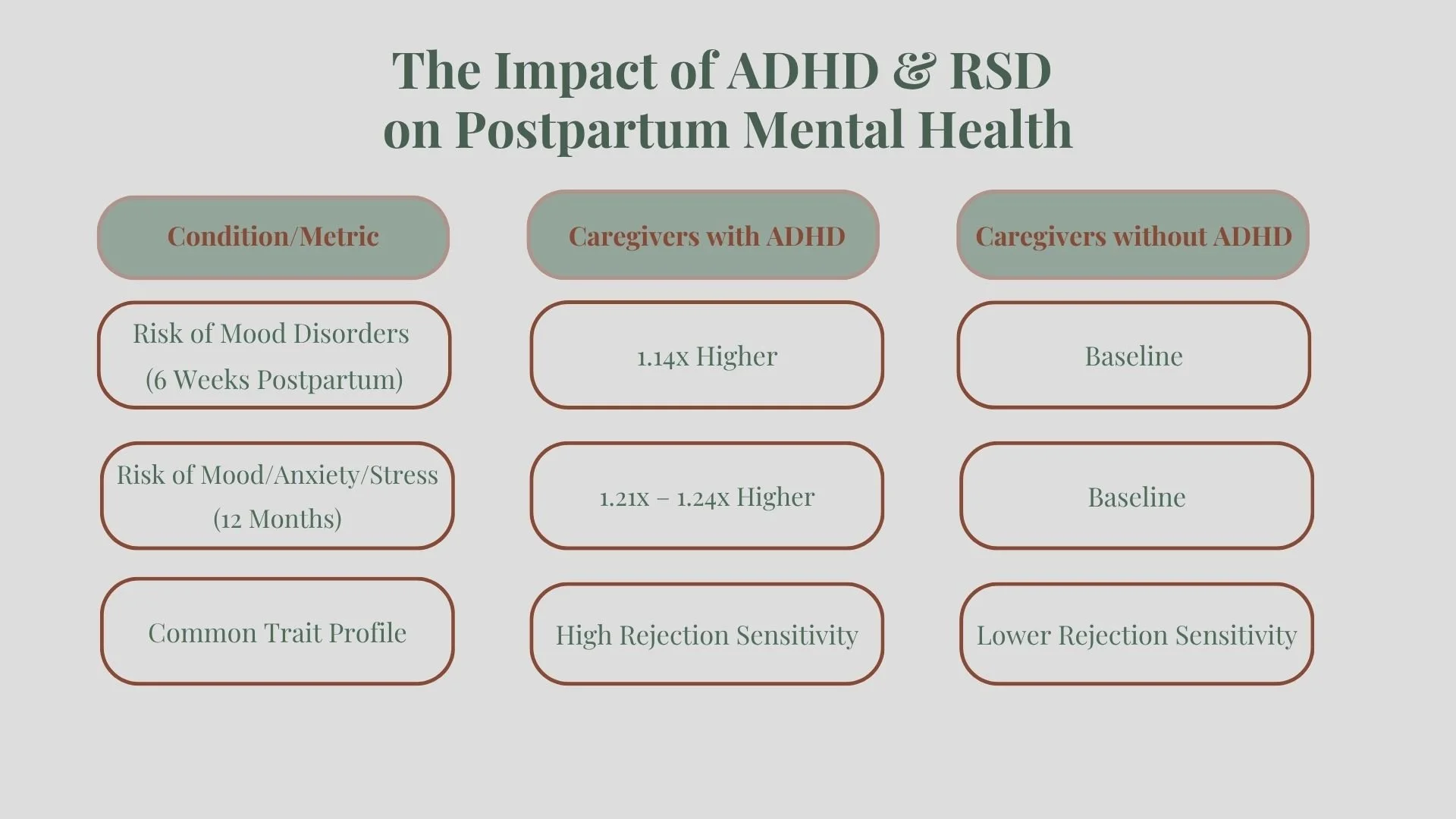
Sensory Processing Sensitivity (SPS) & Infant Temperament: parents high in SPS are more vulnerable to prenatal depression, especially in unsupportive environments. Prenatal maternal distress acts as a stressor that can impact the child. Research shows that higher prenatal depression scores predict increased “fear” temperament subscales in infants by age 3 months, accounting for 22% of the variance in that trait. The statistics in the table above are drawn from a large Swedish register study (Andersson et al., 2023) examining over 773,000 women, of whom 3,515 had a prior ADHD diagnosis.
Managing the Rejection Sensitivity Alarm: A Neuro-Affirming Toolkit
While you may always have a neurological vulnerability to rejection sensitivity, you can learn to work with your nervous system by adding tools in your toolbox so that the alarm has less power over your choices. The keyword here is “with” — not against.
Step 1: Name the Alarm (Catch the Narrative)
When the wave of shame hits, use a script to separate the feeling from the facts:
Internal Script: “My mind is screaming that everyone thinks I’m incompetent. My heart is racing, and my face is hot.”
The Reality Check: “This is my Rejectcion sensitivity alarm going off, not the truth. My nervous system is perceiving a threat that isn’t actually here. This feeling is intense, but it is not a fact.”
You can also try keeping a simple trigger journal, take notes of what happened, what you were thinking, and how your body felt. Patterns will emerge. Perhaps you are most vulnerable when tired, or during certain kinds of social interaction. Awareness doesn’t eliminate the pain, but it helps you to create strategies and prepare for it.
Step 2: Body First — Somatic Tools for Riding the Wave
Your body is in a fight-or-flight state. You cannot "think" your way out of a nervous system hijack. The body has to come first.
From a polyvagal lens, rejection-related distress reflects a nervous system wired for threat detection. The body reacts before the mind can evaluate whether it is actually happening — which is why body-based approaches are so powerful. They speak the language of the nervous system and help it relearn a sense of safety.
There are eight tools I recommend, from breathing and temperature resets to scent anchors, self-hold, and gentle vocalising. Some will land immediately. Others may take practice. A few might not suit your sensory system at all, and that is completely fine.
To make it easy to come back to these when you actually need them, I have put them all together in a free downloadable kit, with simple instructions for each one, including a note for sensory-sensitive parents.
Step 3: Pharmacological Support
Some ADHD specialists, including Dr William Dodson writing for ADDitude Magazine, describe alpha-agonists such as guanfacine and clonidine as potentially helpful for the emotional intensity associated with rejection sensitivity. Some patients describe the effect as “emotional armour” — feedback that once wounded now seems to bounce off. It is important to note, however, that this is based on clinical observation and expert experience rather than formal trials specifically for rejection sensitivity, as it is not yet a recognised diagnosis in its own right. If you are considering going through the medication route, a conversation with an ADHD-informed psychiatrist or GP is the right starting point. If you are pregnant or breastfeeding, this conversation is especially important before making any changes.
Step 4: Supporting Your Partner — and Understanding Theirs

Living with Rejection Sensitivity in a relationship takes two people navigating something neither of them fully chose. This section is for both of you.
If you have extreme sensitivity to rejection:
Have honest conversations about how certain feedback lands for you, not as blame, but as information. Teach your partner about the Rejection alarm so they can help you reality-check rather than inadvertently feed into it.
When you feel the alarm going off, try a reality check script: "My mind is telling me you're disappointed in how I'm handling the baby's sleep. Can we do a reality check? Are you actually feeling that way, or is my sensitivity to rejection alarm just loud right now?"
You might also find it helpful to create a sensitivity to rejection plan together, a simple agreement about how your partner can respond when they notice you are in an episode. Clear signals, short pauses, and gentle repair lines go a long way.
If you are the partner:
This part is for you — and your experience matters too.
Being on the receiving end can be genuinely confusing and painful. You may find yourself walking on eggshells, unsure which version of a conversation will land safely. You may have been yelled at, pushed away, or met with an intensity that felt completely out of proportion to what you said. If you have no awareness of it, you might have concluded that you are simply not good enough, or that nothing you do is ever right.
You are not imagining it. And your feelings about it, the frustration, the exhaustion, the hurt, are completely valid.
What helps to understand is this: the reaction was not really about you. The intensity came from a nervous system that was already in threat mode before you spoke. That does not make it acceptable when it spills over into aggression or withdrawal, but it does make it explainable. And explainable is where change begins.
A few things that can help:
Name what you notice, gently. Rather than reacting to the reaction, say something like: "I can see something's landed hard. Do you want to talk about it or do you need a few minutes first?"
Avoid defending yourself in the heat of the moment. The emotional part of the dysregulated mind cannot hear reason right now. Wait for the window to pass, then revisit.
Ask for the plan. Encourage your partner to share what helps them regulate, and agree together on a signal that means "I need to step away before this escalates."
You deserve support too — whether that is learning more about it together, working with a specialist to build a shared postpartum plan that accounts for both your needs, seeking your own therapy, or simply having your experience acknowledged and that can validate your feelings by someone who understands the dynamic.
The goal is not for one of you to manage the other. It is for both of you to understand the nervous system at the centre of the storm, take responsibility and build something steadier together.
Step 5: Curating Your Parenting Circle
Protecting your nervous system may mean setting firm boundaries. You have the right to limit time with high-criticism family members or skip social obligations that consistently activate your alarm. This is not avoidance; it is nervous system hygiene.
Step 6: Practise Self-Compassion as a Daily Habit
At its core, it often stems from deeply held feelings of defectiveness. Consistent, gentle self-compassion, recognising our shared human imperfections with kindness rather than harsh self-attack, can soften its wounding effects over time.
Try developing a self-compassion phrase for difficult daily life moments: “This is RSD. My brain processes rejection differently. That is a real neurological difference, not a character flaw.
Step 7. Professional Support That Helps — Beyond Standard Therapy
Standard talk therapy is often insufficient for the neurodivergent nervous system, not because therapy does not work, but because the sensitivity to rejection arrives too fast and too intensely for cognition to catch up. By the time you are sitting across from someone trying to process what happened, the moment has already passed, and the shame has already settled. What helps instead is tailored care that works with your neurology rather than around it.
Building Scaffolds
Neuro-inclusive care includes creating external systems, shared digital calendars, visual checklists, and sensory-friendly routines that reduce the cognitive and emotional load before it builds to a crisis point. When your executive function is supported, the nervous system has more capacity to manage what arises.
Addressing the Birth Experience
For many neurodivergent mothers, a difficult or traumatic labour adds a significant layer to rejection sensitivity. When the nervous system has already been overwhelmed by a frightening or out-of-control childbirth experience, the threat-detection response can become even more sensitised in the months that follow, meaning everyday feedback lands harder, and the alarm fires more easily.
If your labour experience left you with unresolved distress, processing that experience is not a luxury; it is often a foundation for everything else. A Neuro-Affirming Birth Debrief offers a structured, trauma-informed space to go back through what happened, understand the clinical picture, and begin to make sense of your story. For those whose childbirth experience has left more lasting symptoms, the 3 Steps Rewind technique is a gentle, evidence-informed approach specifically designed to reduce the emotional charge of traumatic memories without requiring you to re-live them in detail.
Postpartum Planning
Rejection Sensitivity does not exist in isolation; it lives inside a life, a relationship, a household, and a fourth trimester that nobody adequately prepared you for. Neuro-Affirming Postpartum Planning helps you build a realistic, personalised framework for the weeks and months ahead, one that accounts for your sensory needs, your executive function, your relationship dynamics, and your nervous system. For couples navigating it together, it can also be a space to build that shared understanding and plan we spoke about in Step 4.
Perinatal Counselling
Sometimes what is needed is not a plan or a technique but a sustained, containing relationship with someone who understands the neurodivergent perinatal experience from the inside. Perinatal counselling offers space to process the identity shift of matrescence, untangle the patterns that predate motherhood, and build a more settled relationship with yourself — at whatever pace your nervous system allows.
What to Look For in Any Provider
Wherever you seek support, look for someone who is neuro-inclusive, meaning they see your wiring as a difference, not a deficit, trauma-informed, and experienced specifically with ADHD and/or Autism in the perinatal period. These are not standard qualifications. Ask directly.
Not sure which type of support fits where you are right now? That is completely understandable. Navigating this whilst running on a depleted nervous system is not the moment for big decisions.
I offer a free 30-minute introductory call, no pressure, no agenda, just a gentle conversation to explore what you are experiencing and whether any of my services feel like a good fit. You do not need to have it all figured out before you reach out.
You Are Not “Too Sensitive” — Releasing the Shame of RSD
It is time to retire the idea that you need to “toughen up.” Rejection Sensitive Dysphoria is a physiological reality of your unique nervous system, shaped by neurology and often by a lifetime of being misunderstood.
Remember this vital distinction: Failure is an experience — not an identity.
While it may be a lifelong companion, it does not have to define your motherhood. Through early identification, proper support, and deep compassion, you can navigate these intense waters and build a joyful, connected family life.
Have you experienced the RSD alarm in your parenting journey? I’d love to hear from you in the comments. Or if you’d like personalised, neuro-inclusive support to help you build your own toolkit, you’re welcome to reach out for a consultation.