Breaking Down Mum Rage: ADHD and Autism Insights

The first time I screamed at one of my children, I did not recognise the sound that came out of me.
I was in the thick of motherhood. I had survived a traumatic twin birth, a major depressive episode, a long burnout, and the slow-dawning realisation that I was probably autistic. By the time my third daughter was old enough to be in the room when the Mum rage arrived, I had a vocabulary for most of what was happening to me, all except for that. The shame afterwards was the kind that follows you into the next room.
The deeper, more frightening shame of I do not recognise the woman who just did that.
-------------------------------------------------------------------------------------------
If you are reading this somewhere quiet, like the bathroom, the car, the corner of the kitchen, and what is loudest right now is not the rage but the shame, this post is for you. Whether you have a formal diagnosis of ADHD or autism, whether you are still piecing it together, whether you have always identified as an empath or a highly sensitive person, or whether you simply know that your nervous system has always processed the world more intensely than the people around you, you should know that what just happened has a mechanism, a clinical explanation, and a name.
Three Ways to Name the Same Experience
The General Parenting View: "Mum Rage"
A sudden, intense outburst of anger that mothers report most often in the period after childbirth and the early years of caring for small children.
The general research treats it as a symptom of postpartum mood disorders or unmet needs, and there is genuine evidence that it is common: a 2022 Canadian survey found that 31% of postnatal women reported intense anger.
The ADHD literature calls it ADHD rage:
A sudden, intense anger outburst linked to ADHD's underlying difficulty with emotional regulation. Although it does not appear as a formal DSM-5 diagnosis, emotional dysregulation is now recognised by clinicians as a core feature of ADHD in adolescents and adults.
. Around 34–70% of adults with ADHD report experiencing rapid, intense mood shifts, including impulsivity and emotional outbursts that feel harder to control than in neurotypical people.
The autism literature uses meltdown and shutdown:
Two distinct nervous system events that occur when an autistic person can no longer process the demands placed on them.
A 2022 survey of perinatal experiences found that autistic women were significantly more likely than non-autistic women to have experienced a meltdown during the perinatal period (29% vs. 17%) and a shutdown (38% vs. 8%). The shutdown rate is nearly five times higher.
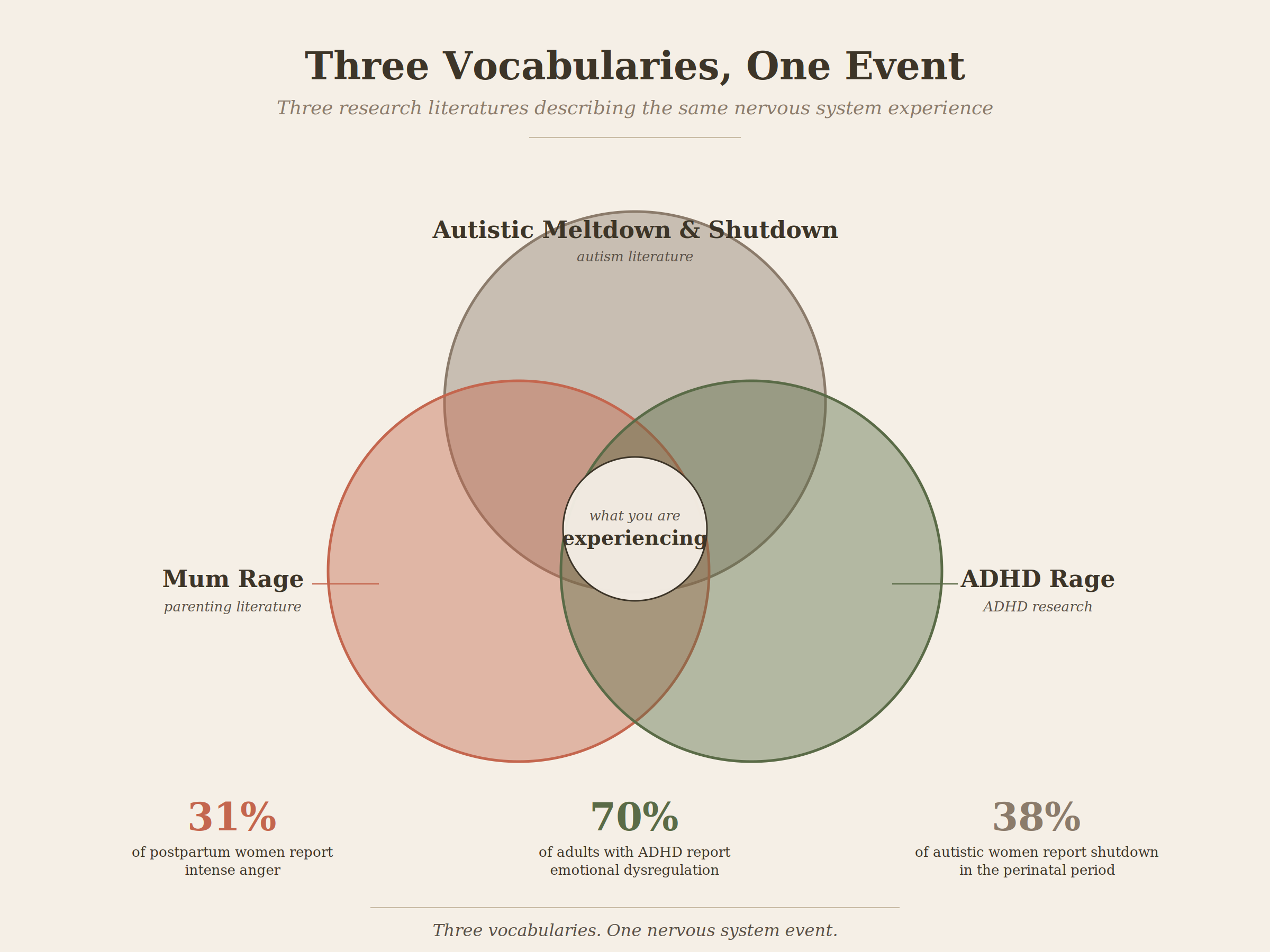
For a mother with ADHD, autism, or both, these are largely the same nervous system event described in three different vocabularies.
This post integrates them. There is currently no published research that names neurodivergent motherhood rage as its own phenomenon; the components have been studied separately. The integration of what happens when ADHD, difficulty regulating emotions, autistic sensory-related and processing differences, and the specific neurological demands of becoming a mother collide in the same body is what I explore here. Neurodiversity research is beginning to close this gap, but the clinical literature has not yet caught up with the lived experience.
What Mum Rage Feels Like From the Inside
There is a particular experience that ADHD and autistic mothers describe again and again. It goes like this:
One moment I was fine. The next, I was screaming.
Not gradually. Not with a warning. Not after a slow build, you noticed and chose to ignore. From zero to a hundred, in what felt like a single second.
The physical cycle is recognisable:
A sudden surge of heat, often in the chest or face
The sensation of something that erupts outward that you cannot contain
Hands that clench without your permission
A voice that comes out louder, sharper, and stranger than you knew you were capable of
The feeling of stepping outside yourself and watching from a distance
A body that then crashes — trembling, cold sweats, spent
A wave of guilt so thick it is almost physical
For neurodivergent mothers, additional features often accompany this:
Sensory input that suddenly registers as painful rather than manageable
A complete inability to filter incoming sound or touch
feeling overwhelmed
A sense that the room itself has become hostile
A brief narrowing of awareness — a few seconds you cannot fully account for afterwards
Or the opposite: hyper-clarity, where every sound and movement registers at unbearable intensity
Whatever the specific pattern, the core experience is consistent. It comes out of nowhere. It feels uncontrollable and perhaps even scary. And you are left feeling guilty, and the heaviness of it all is hard to shift.
What Just Happened — The Mechanism in Plain Language
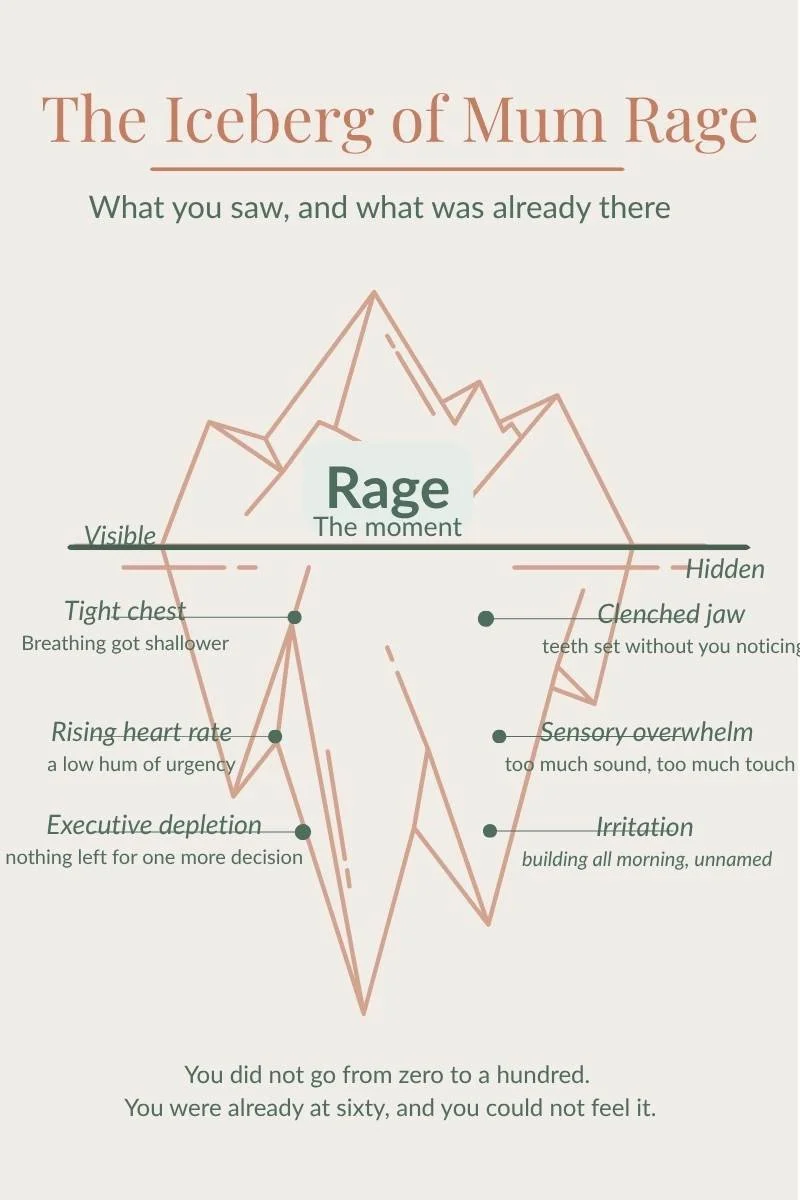
The event you have just experienced is a specific neurological pattern that some practitioners describe as an emotional spike, it can be described as a rapid escalation that occurs because the early-warning system most people rely on is not functioning the way it does in a neurotypical brain.
For autistic and ADHD women, the internal sensing system, which is called interoception, is often quieter than average. Your body is sending signals all day. They are simply not landing in awareness with enough clarity to act on. So you move through frustration, sensory overload, executive depletion, and accumulating irritation without consciously registering any of it. You think you are fine. Until you are not.
This is closely connected to alexithymia, which is a difficulty in recognising and naming what you are feeling from the inside. A 2024 meta-analysis of 32 studies and nearly 8,000 participants found that alexithymia reflects a broader difficulty with interoception, not just a feelings vocabulary problem. The body signals that should provide the early warning, like the tight chest, the clenched jaw, the rising heart rate, the low hum of irritation, do not come through clearly. All that arrives is the rage.
The Hampton survey of perinatal experiences supports this directly: autistic women were significantly more likely to report changes in their interoception (69% vs. 42% reported a change) and proprioception (38% vs. 15%). The interoceptive gap that drives the rage is documented in the perinatal context specifically.
You did not go from zero to a hundred. You were already at sixty, and you could not feel it.
T
he Subtle Signs of an Overloaded System:
sudden irritability or anger.
Shouting, swearing, or crying.
Tension in the body, racing heart, clenched jaw, or feeling like you might explode.
Strong urge to be left alone or get away.
Feeling ashamed or emotionally spent afterwards.
A very short fuse over noise, mess, interruptions, or conflict.
Feeling overstimulated, trapped, or unable to think clearly.
Snapping at children or a partner, then feeling bad about it later.
Headache, tight chest, clenched jaw, racing heart, or shaky body.
A strong urge to escape, hide, or stop everything for a while.
If the anger feels frequent, frightening, or includes thoughts of hurting yourself or someone else, that is a sign to get urgent support.
Why Motherhood Is the Trigger
If you are reading this and thinking, but I never used to be like this, there is a reason. The reason has very little to do with becoming a worse person.
Many neurodivergent women retrospectively recognise that what is happening now follows a recurrence that has been present for years. The flooding, the shutting down, the sense of being overtaken by something larger than yourself, these may have been present in adolescence too. What has changed is that you are responsible for a small person who depends on you, and the same nervous system event lands very differently when it does. The rage that frightened only you at thirteen now frightens a child watching from the doorway.
Inside the Cycle: 4 Mechanisms That Trigger Neurodivergent Maternal Rage
Four mechanisms turn everyday challenges with regulation into the specific phenomenon of maternal rage.
1. Hormonal volatility
Oestrogen is understood to influence dopamine regulation, which affects attention, motivation, and emotional regulation. Across the menstrual cycle, in pregnancy, and most dramatically in the period after childbirth, oestrogen levels shift in ways that destabilise an already vulnerable regulatory system. ADHD and autistic features sharpen. Sensory tolerance drops. The threshold for overwhelm lowers. The recurrence is increasingly recognised in the research, and it is not in your head; it is in your hormones.
2. Masking collapse
The sustained effort of suppressing or concealing neurodivergent traits to appear neurotypical comes with a price, and it is one with a high cost. A 2024 study found that people with ADHD reported significantly higher camouflaging than neurotypical groups, particularly on day-to-day masking behaviours. Matrescence strips the capacity to maintain it. When the mask collapses under depletion, what is underneath is a nervous system running at overcapacity, with regulation resources exhausted, and an early-warning system already impaired.
3. Sensory overload as a fight response
A qualitative study of autistic mothers found that 96% of autistic individuals experience sensory processing differences. Parenting presents extreme sensory demands, constant touch, unpredictable sound, loss of the recovery time and quiet space many autistic women relied on before motherhood. When the sensory system has been overloaded long enough, it responds differently to a neurotypical system. It moves into fight. The rage that follows is what happens when a sensory-overloaded nervous system runs out of capacity to do anything else.
4. Executive depletion
The interaction between autism's need for sameness and ADHD's executive dysregulation creates what one of my clients once described as being completely paralysed by the thing I most want to do. Add the relentless decision-making demands of caring for a small person, every feeding, every nappy change, every transition requiring planning, sequencing, and follow-through, and the executive system is in chronic overdraft. Emotional regulation is dependant of executive function. When executive function is depleted, the emotional braking system loses its primary mechanism.
What for many women shows up as a postpartum meltdown is often better understood as an autistic or ADHD shutdown happening in a body that has nowhere left to discharge it. One autistic mother in a 2021 qualitative study described her postnatal experience as a prolonged meltdown caused by the loss of every coping strategy she had ever relied on, uncertain whether what she had lived through was postnatal depression or something different. Many neurodivergent mothers will recognise this uncertainty.
The Autistic Mother Experience Specifically
Within the broader picture of neurodivergent maternal rage, the autistic mother's experience deserves its own naming. The research base is small but clear.
Autistic women are significantly more likely to experience meltdowns and shutdowns in the perinatal period, both at rates roughly twice as high as non-autistic women, and with shutdown rates nearly five times higher. The reasons are structural and predictable.
The autistic nervous system processes more sensory input, more intensely, with reduced ability to filter or to get used to it. Pre-motherhood, most autistic women had built, many times unconsciously, an entire architecture of recovery: time alone, predictable routines, sensory management, control over the rhythm of social demand. Pregnancy disrupts all of it. The period after childbirth demolishes it.
Add to this the heightened rejection-sensitive dysphoria that affects many ADHD and autistic women: a partner's sigh, a baby who will not settle, a health visitor's tone, all of these can register through the RSD alarm as rejection or failure, which then fires through a postnatal body already in depletion. The rage that follows is not disproportionate to what the nervous system experienced. It is disproportionate only to what actually happened.
If you would like to read more about how RSD overlaps with birth trauma in ADHD and autistic mothers, the pillar post on Rejection Sensitive Dysphoria in motherhood goes deeper.
How Mum Rage Lands on the People Around You
The rage does not happen in isolation. It happens in front of children, partners, and sometimes extended family — and the impact on those relationships is one of the things that makes it so painful to live with.
For children, the pattern matters more than the individual incident. Children are not damaged by parents who lose their temper occasionally. What affects them is an environment where rage is constant and never followed by repair. A calm, age-appropriate repair conversation — what happened was not your fault,I was not angry at you, I was overwhelmed, I am sorry I shouted — is what protects the relationship. Perfection is not the goal. Repair is.
What Can Partners Actually Do?
Partners help most by lowering the load, not by trying to fix the feeling. It helps to agree in advance on a simple signal phrase — something like "I am overwhelmed, I need a few minutes" — so that when it happens, both of you know what comes next.
In the moment, what tends to help:
Take over the children, the noise, and any decisions
Keep speech brief, calm, and concrete — "I've got this, take your time"
Reduce sensory input: lights down, TV off, fewer questions
Offer water, food, a quiet space, or a sensory tool — headphones, a weighted blanket, something grounding
Avoid criticism, problem-solving, or asking for explanations mid-escalation
Try a grounding technique together if she is open to it — slow breathing, where the outward breath is longer than the inward inhalation, or a simple 5-4-3-2-1 sensory scan
The most important thing is to have this conversation before the next escalation, not during it. Partners who understand that rage is a dysregulation response, not a personal attack, become an ally in managing it rather than another source of pressure and resentment.
What Actually Helps — Managing Anger and Mum Rage
Generic advice about this topic was not written with a neurodivergent nervous system in mind.
Sleep when the baby sleeps. Just ask for help. Lower your standards. Every mother finds it hard. You just need a better self-care routine.
For an ADHD or autistic mother in genuine nervous system dysregulation, this advice is not just unhelpful; it can be actively harmful, leading to further isolation and increasing feelings of shame. It assumes a regulatory system that responds to rest the way most people do. It assumes that reaching out feels straightforward. It assumes the difficulty is proportional to a neurotypical mother's, only turned up slightly.
Motherhood rage in a neurodivergent body is a different kind of hard. What helps is different as well.
The interventions that work for neurodivergent mothers divide into upstream and downstream categories. Both matter. The upstream category matters more.
Upstream: building the early-warning system
If the rage arrives without warning because the warning signals are not being received, the most leveraged intervention is upstream. You can do this by building interoceptive awareness so the body's signals become legible before the crisis point. Rather than trying to label emotions, the work is to scan the body and recognise physical sensations: where there is tightness, where there is heat, where there is nothing. Restoring the body–emotion link is what rebuilds the foundation for self-regulation. It takes time. It works.
The Recovery Map and the Body Signal Tracker are both designed to support this upstream work specifically.
Environment modification before behaviour change
Burnout is the result of too much stress and insufficient resources to cope with it. For neurodivergent mothers, the most effective initial intervention is rarely a new skill; instead, the focus needs to be on reducing the load. Sensory load. Decision load. Social load. Reducing demands, simplifying routines, and protecting genuine recovery windows is structural work that reduces the frequency of the rage before any therapeutic work on the rage itself begins. Setting boundaries as an ADHD mother is the practical companion piece on this.
Concrete environment changes that often help:
Recognise your sensory triggers and reduce them where possible. Lower lighting, noise-cancelling headphones, soft clothing, fewer mirrors and reflections.
Normalise asking for true recovery time, not just a break. Twenty minutes alone in a quiet room is different from twenty minutes with the baby on the other side of a thin wall.
Build pattern recognition into the week. Notice which days, hours, or transitions consistently bring you closest to the spike. Adjust the structure where you can.
Reconnect with the strategies you used before motherhood. Many were stripped away by the period immediately after childbirth. Some can come back, in an adapted form.
Therapeutic Frameworks: DBT, CBT, and Trauma-Informed Support
DBT components
has solid evidence for emotional dysregulation in adult ADHD. Specifically useful for motherhood rage are chain analysis — recognising the sequence of events, thoughts, and feelings leading up to an outburst — and opposite action — practising a different response to help regulate the nervous system. These are concrete, teachable, and compatible with a neurodivergent brain when framed correctly.
CBT — useful, with one caveat
Standard cognitive behavioural therapy assumes the person can identify and label their emotional state before responding to it. For ADHD and autistic women with alexithymia, this assumption breaks down. CBT works best after some interoceptive foundation has been built, or when adapted specifically for alexithymic presentation. Ask any therapist before starting work whether they have experience adapting their approach for neurodivergent or alexithymic clients.Trauma-informed support
For women where maternal rage is entangled with birth trauma, which the research suggests is significantly more common in women with ADHD and autism, the anger is partly a trauma response, not purely a dysregulation response. Trauma-informed and somatic approaches are needed alongside any skills-based work, and you can start addressing this through a Birth Debrief.
Perinatal-specific support
The 2024 systematic review on the neurodivergent perinatal experience was clear: generic perinatal support is documented as inadequate for women with ADHD and autism. What is needed is constructive, practical support that is specifically perinatal and specifically neuro-affirming. That is what I offer through Perinatal Counselling.
Frequently Asked Questions
Is mum rage the same as ADHD rage?
Not exactly. ADHD rage is the broader structural condition; it relates to the emotional dysregulation that is now recognised as a core feature of ADHD, affecting roughly 70% of adults with the condition. Maternal rage is one specific context in which ADHD rage manifests in the postnatal and early-parenting context, where hormonal shifts, lack of sleep, sensory demands, and the witness pressure of being watched by your child all amplify the underlying dysregulation. A woman can have ADHD rage without being a mother. A neurodivergent mother who experiences this is, in clinical terms, having ADHD or autistic emotional dysregulation in a uniquely demanding context.
What is the difference between mum rage and postpartum rage?
The two terms are often used interchangeably, but they are not identical. Postpartum rage refers specifically to anger that emerges in the first year after birth and is most often discussed as a symptom of perinatal mood and anxiety disorders. Maternal rage is the broader umbrella term for maternal anger across the parenting years, including, but not limited to, the period after childbirth. Many mothers experience both: postpartum rage that begins in the early months and continues to surface as mum rage years later when the structural pressures of parenting persist. For neurodivergent mothers specifically, the underlying mechanism tends to be consistent across both phases.
How is mum rage different from postpartum depression?
They can overlap, with irritability being recognised as a feature of PPD, and approximately one in four postnatal women experience some form of perinatal mental health condition. The two are distinct, however. PPD involves persistent low mood, loss of interest, and often guilt or feelings of worthlessness. It is acute and explosive, a sudden spike of anger that feels uncontrollable in the moment and is followed by intense shame. They can co-occur. Both deserve attention if you are experiencing both. A perinatal mental health practitioner can help you distinguish them.
Is what I am experiencing an autistic meltdown or shutdown, actually?
For autistic mothers specifically, yes. What is often called mum rage is, in a meaningful proportion of cases, what the autism literature calls a meltdown (an externalised overwhelm response involving expression and discharge) or a shutdown (an internalised overwhelm response involving withdrawal and reduced functioning). The 2022 perinatal experiences survey found these occur at significantly higher rates in autistic mothers than in non-autistic mothers. Whichever term you use, the underlying nervous system event is the same, but the language can change the kind of support that helps.
Why does mum rage feel worse when my child is the trigger?
Several factors converge. The witness pressure: your child is watching, and your nervous system knows this. The maternal-instinct override conflict, the pull to protect and the rage spike occupying the same body. The shame architecture: the cultural mythology of motherhood makes the rage feel like a deeper failure than it would in any other context. And, for many neurodivergent mothers, sensory triggers from the child, specifically, like touch, sound, unpredictability, can overwhelm the nervous system in a particular way. None of these means you love your child less. They mean motherhood is structurally demanding for a nervous system like yours.
Can mum rage harm my child?
Rage frightens children, and repeated rage without repair can affect a child's sense of safety. This cycle holds whether the mother is neurodivergent or not. What also matters is what comes after. Repair conversations, which can only take place once your nervous system has come down, are protective. Children are not damaged by parents who lose their temper occasionally. They are affected by environments where rage is constant, unpredictable, and never followed by repair. If you are concerned about how often the rage is happening or how it is landing on your child, that is exactly the kind of thing worth talking through with a perinatal counsellor or therapist.
Do I need an ADHD or autism diagnosis before I can get help?
A formal diagnosis can open access to specific accommodations and services, and many women find it validating, but it is not a prerequisite for support. You do not need a diagnosis to access counselling, to understand how your nervous system works, or to start making changes that reduce overwhelm. If you recognise yourself in this post, support can begin wherever you are right now.
When should I seek professional help for mum rage?
Several signals warrant professional support: when the rage is happening frequently and you cannot identify what is driving it; when you are frightened of what might happen during an outburst; when it is affecting your relationship with your child or partner in a sustained way; when it sits alongside other symptoms like persistent low mood, sleep difficulties, or intrusive thoughts; or when it is connected to unresolved birth trauma. A perinatal counsellor who understands ADHD and autism is the most direct route. Your GP can also refer you to local mental health services. If you are in crisis or feel at risk of harming yourself or your child, contact emergency services or your local crisis line immediately.
Moving Forward: Compassionate Change is Possible
Understanding that you are AuDHD, have ADHD, are autistic, or simply have a brain that has always worked this way does not make the rage acceptable. It means there is a reason behind it. There is a difference between the two, and the difference matters.
The rage is the visible part of an invisible mechanism that has been building for hours, days, sometimes weeks, in a body that could not tell you it was happening. Identifying the mechanism is the first part of changing what happens next time — and reframing it from a character flaw into a brain-based pattern is what makes the work of change actually possible.
You are a woman whose brain processes the world differently, and who, on top of that, is doing one of the most demanding jobs a human can do, often without enough sleep, often without enough support, often without language for what is happening inside her. That is a context that requires the right kind of help.
If you would like to explore what neuro-affirming perinatal counselling looks like for you, a free 30-minute discovery call is a good place to start. No commitment, no pressure.