Practical Tips for Setting Boundaries as an ADHD Mum

Understanding Why Mainstream Advice Doesn't Work for Setting Boundaries as an ADHD mother and practical tips that actually doI spent years believing that setting boundaries was a discipline problem. That if I just committed more firmly, said no more consistently, followed through more reliably, eventually it would click. It didn't. What changed everything wasn't more effort; it was understanding, after my own AuDHD diagnosis, that boundary-setting is an executive function. It requires working memory, impulse regulation, emotional processing, and cognitive flexibility, all firing simultaneously. If you're an ADHD or neurodivergent or highly sensitive mother who has tried every script and framework going and still finds yourself caving, over-explaining, or collapsing in guilt afterwards, this is for you. Not because you're doing it wrong. Because the tools were built for a different brain.
What ADHD Actually Means for Mothers
Before we can talk about setting boundaries, it helps to name what we're actually working with. Attention deficit and hyperactivity disorder affects far more than attention. For women with ADHD, and particularly for those who received a late diagnosis, the condition shapes emotional regulation, impulse control, sensory processing, and the capacity to hold structure under pressure, which are things that motherhood demands in abundance, often simultaneously.
Impulsivity, emotional dysregulation, and difficulty regulating emotions in real time are not personality traits. They are neurological patterns. And when those patterns collide with the relentless demands of early motherhood, like the noise, the physical contact, the invisible mental load, the constant context-switching, they don't just persist. They intensify. Understanding this is not an excuse. It's the starting point for finding approaches that actually work.
Why Setting Boundaries Is Harder When You Have ADHD
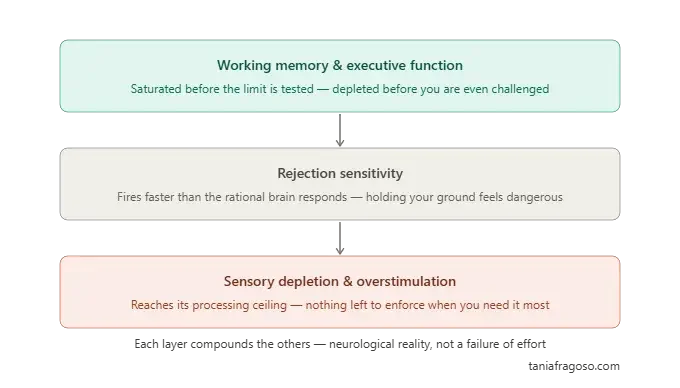
Mainstream parenting advice assumes three things: that you can recall yesterday's decision clearly enough to enforce it today, that your emotional capacity holds steady across the day, and that your energy is predictable enough to follow through when you're tested. For most ADHD mothers, none of those assumptions is reliably true, and that gap between expectation and capacity is where the shame begins.
These are the neurological realities that make this harder.
Working Memory, Dopamine, and Executive Function
Setting boundaries is not a values problem. It is an executive function task. To hold a limit under pressure, you need to remember what you decided, regulate the emotional discomfort of the pushback, override the impulse to give in, and do all of this in real time. All this while probably also being touched by a small person and asked what's for lunch.
There's a dopamine dimension here too. The ADHD brain is not wired to sustain effort on tasks that don't provide immediate feedback or reward, and enforcing a boundary rarely feels rewarding in the moment. It often feels like the opposite. Research confirms that working memory and self-regulation are central to consistent parenting behaviour, and both are significantly affected by ADHD.
Rejection Sensitivity and Emotional Dysregulation
Many ADHD and neurodivergent or highly sensitive mothers experience rejection-sensitive dysphoria, which can be explained as an intense emotional response to real or perceived criticism that can feel physically overwhelming. When your child melts down in response to a limit you've set, or your partner questions a decision you've made, your nervous system fires faster than your rational brain can respond.
Emotional dysregulation in these moments is not an overreaction. It is a physiological response where the nervous system reads social disconnection as a threat. And when the body is in threat response, holding a considered position becomes genuinely difficult, regardless of how clearly you knew what you wanted to say five minutes earlier.
This is why people-pleasing is so common in women with ADHD. Saying yes when you actually mean no is a result of years of conditioned behaviour, and it is your nervous system trying to protect you from a kind of pain that runs very deep. If this resonates, the RSD First Aid Kit below has practical, body-based tools specifically for these moments.
Overstimulation and Sensory Depletion
By the time you have navigated the noise, the touching, the questions, and the relentless decision-making of an ordinary day with young children, there is often nothing left to draw on for setting boundaries. Overstimulation is a result of a nervous system that has reached its processing limit and is beginning to shut down or spike, and in that state, maintaining any limit becomes almost impossible.
The sensory and cognitive demands of motherhood are significant for any parent — for ADHD and Autistic mothers, this is neurologically different in kind, not just degree. What looks like inconsistency from the outside is frequently depletion. Not failure. Depletion.

How ADHD Affects Parenting and Family Dynamics
Setting boundaries is not just an internal challenge; it plays out in the relationships around you. For ADHD mothers, this often shows up in particular patterns: difficulty communicating boundaries clearly and consistently to a partner, children, or extended family; feeling that the rules shift depending on your sensory state that day; struggling to repair after moments where overstimulation led to a response you didn't intend.
Family members and partners who don't understand ADHD may read inconsistency as unreliability, or emotional responses as disproportionate. This misreading can feel isolating and can significantly affect self-esteem over time. Communicating boundaries — not just setting them, but explaining the framework behind them — becomes an important part of making them sustainable. "When the house gets loud in the evening, I need fifteen minutes of quiet before I can be present again" Creating a clear expectation of your needs and providing context about your capacity is about providing information that protects the relationship.
ADHD also affects how children experience boundaries. A mother who enforces limits firmly one day and lets everything slide the next isn't failing at parenting, she is rather parenting with a variable nervous system. Children tend to adapt to the predictability of intention rather than the consistency of enforcement. The goal is for them to know what you value, not for you to be a machine.
Why Mainstream Advice Makes It Worse
Most parenting frameworks were built for neurotypical nervous systems. They assume consistent memory, stable emotional capacity, and predictable energy, and when those aren't available, they respond by recommending more structure, more consistency, more rigidity. For an ADHD brain, this doesn't just fall short. It actively compounds the problem.
The cycle is familiar: try the framework, struggle to maintain it, feel ashamed of the gap, try harder, burn out, and feel overwhelmed again. Break the cycle long enough to feel like you're managing, then watch it collapse under the next difficult week. And eventually, conclude that the problem is you. It isn't. The Maternal Mental Health Alliance has highlighted that most maternal mental health support rarely accounts for neurodivergence — meaning the majority of ADHD mothers are trying to use tools that were never designed for how their brain actually works.
You don't need more discipline. You need a different approach.
A Neuro-Affirming Approach: Practical Tips That Actually Work
What works for women with ADHD is not a more rigid system. It is fewer, clearer, more sustainable limits, which are built around how your brain actually functions, not how parenting books assume it should.
Fewer Limits, Chosen Deliberately
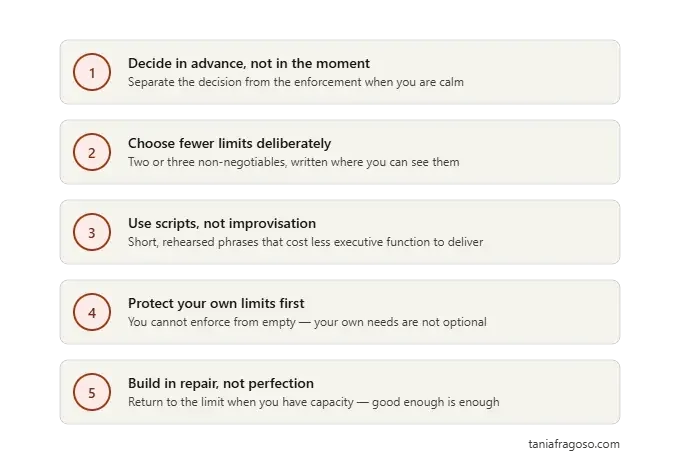
The most effective shift I know, and which I have experienced in my own life and in my work with clients, is separating the decision from the enforcement. When you are calm, not overstimulated, and not mid-meltdown, decide on two or three genuine non-negotiables. Write them somewhere visible. The goal is to remove the need for real-time executive function at the exact moment you have the least of it available.
Choose fewer boundaries, and make them matter
An ADHD brain manages a small number of clear, repeatable expectations far better than a comprehensive list of rules. This is a strategic allocation of a genuinely limited resource. The limits you choose should protect three things: safety, sleep, and your nervous system. Everything else can hold more flexibility than most parenting books will tell you is acceptable.
Use scripts, not improvisation
Pre-written phrases reduce the cognitive load of the moment considerably. "We don't hit." "Screens off at seven." "I need five minutes." Short, rehearsed, repeatable. The simpler the script, the less executive function it costs to deliver it when you're already depleted — and you will often be depleted when you need it most.
Protect Your Own Limits First
You cannot regulate your children's behaviour when your own nervous system hasn't been given what it needs. What time do you need the noise to stop? When do you need to stop being touched? What restores you between the demands? Attending to these needs is the foundation that makes everything else possible. An ADHD or neurodivergent or highly sensitive woman whose own limits are chronically unprotected will find that self-care and self-regulation become increasingly inaccessible over time, not because of character, but because the well is genuinely empty.
Build In Repair, Not Perfection
You will not be consistent every day. That is not a failure. What matters more than consistency is repair, by returning to the limit when you have capacity, naming what happened, and showing your children that limits can hold even when they bend occasionally. Good enough is genuinely good enough, and it is a far more accurate and sustainable goal for an ADHD brain than perfect.
A note on mindfulness: it is often recommended as a tool for emotional regulation, and for some ADHD mothers, it genuinely helps. For others, traditional mindfulness practices feel overwhelming or inaccessible, particularly if interoception is unreliable. If mindfulness hasn't worked for you, there is a reason for that, and you should not equate it to failure. Body-based, movement-led, or sensory-anchored approaches may serve you better.
Setting boundaries as an ADHD Mum:
Practical Tips That Actually Work
Five neuro-affirming strategies for setting limits as an ADHD mum, including deciding in advance and building in repair over perfection
When the Struggle Is Bigger Than Boundaries
There's a difference between hard days and a pattern that doesn't shift. If you're noticing chronic exhaustion that sleep doesn't fix, emotional numbness, a persistent sense of going through the motions, or signs of burnout that look more like shutdown than tiredness, these are all signs that are worth paying attention to.
Sometimes what presents as a boundary problem is something else underneath: an unprocessed birth experience, an unrecognised burnout cycle, postpartum depression that has gone unidentified because it didn't look like the textbook version, or a nervous system that hasn't had the space to recover from the transition to motherhood. These are not things a better morning routine will reach.
Working with a psychologist or neuro-affirming counsellor who understands ADHD can help you identify which layer you're actually working with, and then find the kind of support that matches it. If you've been carrying a quiet sense that something feels off, it may be worth considering that the right support could change the way you experience everything. A free consultation is a place to start, not to commit to anything, just to find out whether what you're carrying has a name.

Frequently Asked Questions
Why is boundary-setting so hard for ADHD mothers?
Because it relies on executive functions — working memory, impulse regulation, emotional processing, and flexible thinking — all of which ADHD affects. Add the sensory and cognitive demands of motherhood, and the system becomes overwhelmed quickly. This is not a character flaw. It is a neurological mismatch between the demands and the available resources.
What do realistic limits actually look like for an ADHD mum?
Simple, few in number, and focused on protecting safety and nervous system capacity. Choose two or three genuine non-negotiables, write them down, and let everything else hold more flexibility. The goal is sustainability — a system that holds under real conditions, not a perfect framework that collapses under pressure.
Why do I feel so guilty when I enforce a limit?
Guilt around saying no often connects to rejection sensitivity — a common experience for ADHD and neurodivergent mothers where saying no can feel emotionally dangerous at a nervous system level, even when you know rationally it's the right call. If the guilt is persistent and overwhelming, it may be worth exploring with a neuro-affirming counsellor who understands the emotional complexity underneath.
How do I communicate boundaries to my family when they don't understand ADHD?
Start by explaining the framework rather than just the rule. "My nervous system needs quiet in the evenings to reset" gives more information than "I need you to stop talking to me after eight o'clock" — and it invites understanding rather than just compliance. It can also help to have these conversations at a calm moment, not mid-trigger, and to put the key ones in writing so they don't rely on memory in either direction.
Does it matter if I'm not consistent every day?
Consistency is the most overrated word in parenting. What matters more is predictability — your children knowing what the expectation is, even when it isn't enforced every single time. Build in repair: return to the limit when you have capacity, name what happened, and move on. That teaches resilience far more reliably than rigidity.
When should I consider professional support?
If the struggle with limits is part of a wider pattern — burnout, chronic depletion, emotional overwhelm, or difficult experiences that haven't been fully processed — individual support can help you work with what's underneath, not just manage the surface. A neuro-affirming counsellor or psychologist works with the emotional and relational layers alongside the practical.
What's the difference between ADHD coaching and counselling for this?
ADHD coaching typically focuses on practical systems, accountability, and skill-building — genuinely useful for strategy and structure. Counselling works with the deeper layer: the emotional patterns, the relational history, the nervous system responses that practical tools alone can't reach. Many ADHD mothers find both helpful at different points.