Understanding Alexithymia in Autistic & ADHD mothers

What is alexithymia — and why does it affect so many autistic and ADHD people?
There is an emotion wheel sitting on my desk. The kind that radiates outward from the simple words at the centre, happy, sad, angry, afraid, into ever finer distinctions. I used to sit with it with my children, trying to name what we were all feeling.
I could find the simple words easily enough. But as we moved outward, toward the nuance, the gradations, the specific textures of feeling, I got lost. Completely and quietly lost.
I was trying to give them a map that I did not possess.
If you recognise that experience, the feeling deeply and intensely, and yet struggle to locate or describe what is actually happening inside you, know that there is a name for it. It is called alexithymia. And if you are autistic or have ADHD, there is a significant chance it is part of your experience too.
Research suggests that this could affect just under half of all autistic people, as opposed to just a small percentage of the general population.
This is not a flaw. It is not a failure of self-awareness or of healing. It is a specific feature of how some nervous systems process the world. And understanding it changes everything.
In this article
Alexithymia is difficulty identifying and describing emotions — not an absence of feeling. The feeling arrives; the label does not.
It affects around 50% of autistic people, compared to roughly 5% of the general population. It is also common in ADHD, where it often underlies emotion regulation difficulties.
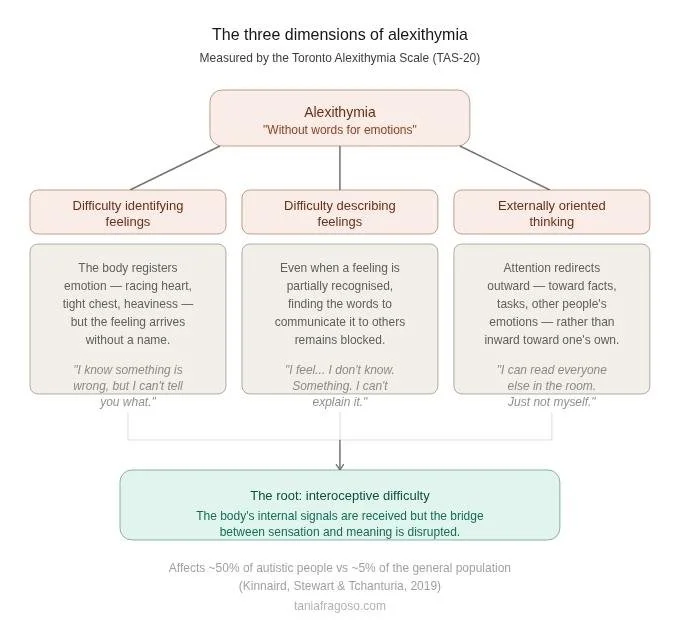
It is rooted in interoception — the body's ability to read its own internal signals. When that pathway is disrupted, standard emotional awareness strategies simply don't work.
People with alexithymia often feel empathy very deeply, particularly affective empathy. The difficulty is in naming and processing what they feel — not in feeling it.
Body-based approaches — movement, breathwork, somatic therapy — offer a different route in when the cognitive path is blocked.
Alexithymia in motherhood is not a failure to love. It is a specific processing difficulty, and it can be understood and worked with.
What is alexithymia?
Alexithymia is a trait characterised by difficulty identifying, describing, and processing emotions, not an absence of feeling, but a disruption in the bridge between bodily sensation and emotional language.
The term comes from the Greek: ‘no words for emotions’. It was first described by psychiatrist Peter Sifneos in 1973 to capture a cluster of difficulties that some of his patients shared: they struggled to identify and express their feelings to others, and tended to have an externally oriented thinking style rather than an inward.
Crucially, it's not emotional numbness. It does not make people indifferent. The internal body still receives emotional input that manifests through a racing heart, a tight chest, heaviness in the limbs, and shallow breath. What is disrupted is the bridge between those bodily sensations and the words that give them meaning. The feeling arrives. The ability to identify emotions does not.
This distinction matters. Difficulty with identifying and describing emotions is not the same as not having them. And many people, despite it, feel a great deal, but they cannot access the emotional vocabulary to make sense of it. It is, at its core, a difficulty with the internal body as a source of information.
Is alexithymia a mental health disorder?
Alexithymia is not a clinical diagnosis in itself. It does not appear in the DSM or ICD as a standalone condition. It is better understood as a trait. A specific pattern of interoceptive and emotional processing that exists on a spectrum and that frequently co-occurs with other conditions rather than causing them directly.
Relationship with Depression
In depression, emotional numbness and alexithymia can look similar from the outside, but they are distinct: depression blunts the emotional signal, while alexithymia disrupts the ability to read it. A person can be alexithymic without being depressed, and depressed without being alexithymic, though when both are present, recovery is often slower, because standard talking therapies depend on an emotional access that may not be reliably available.
Relationship with PTSD
It is commonly found alongside people with PTSD, (post-traumatic stress disorder), which can be from childhood trauma or birth trauma, though the relationship is not straightforward. It can cause alexithymia-like states — dissociation, emotional shutdown, a numbness that protects the system from what it cannot yet process.
The distinction is important, for what kind of support will actually help. One is a wound response; the other is a nervous system feature. For mothers carrying unprocessed birth trauma, the shutdown that followed may feel like an inability to feel, and in some cases, it may be both: a traumatic freeze layered over a nervous system that already struggled to name what it felt.
How does alexithymia affect anxiety?
Alexithymia means anxiety rarely announces itself clearly. Instead of a recognisable feeling of worry, it accumulates silently in the body: as a jaw clench, shallow breathing, or irritability, often reaching a high level before it becomes legible at all.
This has two significant consequences:
First, it can lead to catastrophising when emotion does break through, because the signal went unread for so long that it arrives as a flood rather than a warning.
Second, standard anxiety management strategies that begin with "notice when you start to feel anxious" are largely inaccessible. The noticing mechanism is what is impaired.
For mothers in particular, this may help explain why anxiety so often registers as irritability, restlessness, or a sudden inability to start tasks, rather than the identifiable worry that therapy tends to address.
Emotional suppression
It is also worth naming what alexithymia is not: it is not emotional suppression. Suppression is an active, often learned process of pushing feelings down. Alexithymia is not a choice and not a defence. The feeling is not being hidden. It is simply not arriving in a form that can be named.
What are the symptoms?
The most recognised symptoms of alexithymia include difficulty identifying feelings, difficulty describing them to others, and a tendency toward externally oriented thinking.
Difficulty identifying feelings — knowing something is happening inside you, but having no word for it
Difficulty describing emotions to others — finding emotional conversations stilted, vague, or exhausting
Physical symptoms without emotional awareness — a racing heart, tight chest, or nausea that arrives before any conscious emotional signal
Externally oriented thinking — focusing on facts, logistics, and other people's experiences rather than your own inner world
Confusion between emotions and physical sensations — not knowing whether what you feel is anxiety, hunger, pain, or overwhelm
A sense of emotional blankness after events that "should" feel significant — births, losses, milestones
For autistic and ADHD mothers, many of these overlap with sensory processing differences, making them even harder to identify without a framework that names them clearly.
“Alexithymia is not emotional numbness. The feeling arrives. The ability to label it does not.”
How is alexithymia measured?
The most widely used tool is the Toronto Alexithymia Scale (TAS-20), a questionnaire which assesses three dimensions: difficulty identifying feelings, difficulty describing feelings to others, and externally oriented thinking.
The validity of using self-reports to assess emotion and alexithymia has been debated in the literature. Some researchers note that self-report measures may underestimate it, since the very difficulty being measured can interfere with accurate self-assessment.
Nevertheless, the TAS-20 remains the gold standard in research and consistently shows that autistic adults and people with ADHD score significantly higher across all dimensions than neurotypical comparison groups.
The overlap between alexithymia and autism spectrum disorder
The overlap is one of the most significant findings in recent neurodivergent research, and one of the least known outside clinical settings.
A landmark systematic review and meta-analysis by Kinnaird, Stewart and Tchanturia (2019, European Psychiatry) examined fifteen studies using the TAS-20 and found a weighted mean prevalence in autistic populations of just under 50%, compared to around 5% in the general population.
The prevalence varied across studies from 33% to 63%, reflecting differences in sample characteristics; however, in every study, autistic people had it at a dramatically higher rate than typical development comparisons. For many autistic people, it is a co-occurring experience, not an exceptional one.
Similarly, in ADHD populations, high levels of alexithymia are increasingly recognised as a contributing factor in emotion regulation difficulties, particularly in relation to attachment patterns and impaired emotional processing. The presence of alexithymia in ADHD may help explain why standard emotion regulation strategies so often fail: they assume an interoceptive access that may not be reliably available.
The alexithymia hypothesis
One of the most important theoretical shifts in this field involves what is known as the alexithymia hypothesis, proposed by Geoff Bird and Cook (2013, Translational Psychiatry). Their argument is this: many of the emotional and empathy-related difficulties traditionally attributed to autism, and used as diagnostic criteria for autism, may be better explained by co-occurring alexithymia. When alexithymia is controlled for in research, many of the differences in emotional processing between autistic and non-autistic groups largely disappear.
This has significant implications for how autistic and alexithymic people understand themselves. Alexithymia could be responsible for a range of experiences, difficulty with facial expression recognition, challenges in social-emotional reciprocity, and impairment in emotional availability, which have historically been attributed to autism itself. The two conditions, overlap between alexithymia and autism, are substantial, but they are distinct. And disentangling them matters for how support is offered.
Geoff Bird and colleagues have also proposed attention-appraisal models of alexithymia, suggesting that alexithymia may arise from difficulties in attending to and appraising bodily signals, a fundamentally interoceptive process. Poquérusse and colleagues (2018, Frontiers in Psychology) describe alexithymia as "both a cause and consequence of autistic experience", shaped by genetics, neurobiology, and environment in ways that are, for many people, impossible to separate.
Which raises a question worth sitting with: what does it do to a child who already feels inherently different, too sensitive, too much, too intense, to grow up without anyone ever naming what they feel? The models of alexithymia that acknowledge environmental factors suggest that for autistic and ADHD people raised without emotional modelling, the neurology and the wound may have grown together into something that feels like one thing.
Do people with alexithymia feel empathy?
This is one of the most searched questions about alexithymia, and the one that is most misunderstood. Because the paradox that many autistic women and ADHD mothers describe — often without language for it — is this: they feel deeply, acutely, sometimes overwhelmingly, and yet cannot say what it is they are feeling.
Yes. People with alexithymia feel empathy. In many cases, they feel it so acutely that it becomes overwhelming. What may be reduced is the cognitive component: the capacity to step back, label, and process another person's feelings in a structured way. But affective empathy — the felt resonance with another person's emotional state — is often heightened, not reduced.
Researchers are beginning to call this empathic disequilibrium: an imbalance where emotional empathy surpasses cognitive empathy, creating a specific and painful experience — absorbing what others feel with extraordinary precision, while remaining unable to name or process what belongs to themselves.
Research by Bos and colleagues (2023, Personality and Individual Differences) found that autistic traits were linked to reduced cognitive empathy but increased affective empathy for negative emotions. Shah et al. (2019) found that autistic traits were actually a stronger predictor of higher affective empathy than alexithymia itself. Butera and colleagues (2023) found no deficit in emotional empathy in their autistic sample — only differences in how that empathy was processed internally, with alexithymia severity correlating with higher personal distress. Zhang and colleagues (2025) confirmed through network analysis that the systems of feeling and naming operate independently: high affective empathy and high alexithymia can, and frequently do, coexist in the same person.
The emotional symptoms of autism are not what they have long been assumed to be.
Autistic women in particular often describe this as the central confusion of their inner lives. They have been told they are too sensitive, too reactive, too much. They have rarely been told that their sensitivity is real. That their empathy is real. And that the difficulty with describing the emotions they feel does not diminish either.

When the internal world becomes illegible, perception redirects outward. This is the mechanism behind hypervigilance in many autistic and ADHD people: an exquisitely refined system for reading others, developed because, at some point, reading the room was essential to survival. Alexithymia may intensify this; the less you can locate your own emotional state, the more acutely attuned you become to the emotional states of everyone around you. You feel it like it is your own. And the boundary between self and other erodes.
The impact of alexithymia on relationships and motherhood
The effects ripple outward into every close relationship. Difficulty with identifying and describing feelings affects how people with alexithymia engage in emotional reciprocity, not through indifference, but because emotion recognition begins with the self, and that starting point is disrupted.
In the context of motherhood, this becomes particularly significant. The FinnBrain Birth Cohort Study (Ahrnberg et al., 2021, Frontiers in Psychology) found that maternal alexithymic traits at six months postpartum were associated with lower sensitivity and higher hostility in caregiving at eight months, associations that held even after controlling for maternal depression and anxiety. Crucially, the role of alexithymia here is not aggressive hostility: it manifests as emotional flatness, impatience, and reduced availability. And in the same studies, most mother-infant interactions were still coded as "good enough." Awareness of the pattern is itself the beginning of change.
Autistic mothers who are parenting face compounded demands: the sensory load of caregiving, the executive function required, the emotional attunement that is asked of them, all while navigating a nervous system that is already working harder than most. In this context its not an absence of love or care. It is an impairment in the specific pathway that converts emotional experience into readable, shareable signals.
How to live with someone with alexithymia — and what it means for your closest relationships
The experience can be quietly disorienting. They are clearly present, clearly caring, and yet, sometimes unable to give you the emotional reflection you were hoping for. The conversation that needed them to say "I can see you're hurting" ends with a practical solution you didn't ask for. The milestone you shared passed without the response you expected.
Understanding alexithymia changes this dynamic significantly.
What helps in relationships where one person has alexithymia:
Name the emotion for them, without pressure. "It looks like that was a lot. Is that close?" gives them something to confirm or correct rather than generate from scratch.
Accept physical presence as emotional presence. Being in the same room, making tea, sitting alongside, these are often the equivalent of "I am here with you."
Avoid "how do you feel about this?" in high-stakes moments. The question demands a kind of access that may genuinely not be available. Try instead: "What do you notice?" or "What are you thinking about this?" A cognitive door may be more accessible.
Understand that a flat response is not indifference. The absence of visible emotion is not the absence of feeling. It is the absence of the translation.
For mothers, this section matters in another direction too: you can parent warmly and consistently without a running emotional commentary. Presence, co-regulation, and physical attunement are all available to you, even when the words are not.
Alexithymia and interoception: the root of the difficulty
If alexithymia is the condition, interoception is its root.
Interoception is the body's sense of its own internal state: hunger, temperature, heartbeat, pain, and, critically, emotion. Research by Geoff Bird and colleagues (2016, Royal Society Open Science) proposed that Alexithymia is fundamentally a general deficit of interoception, not a specific emotional processing difficulty.
This connection means that when interoceptive signals are weak or unclear, the body can still register emotional activation. This can manifest through a tight chest, heavy limbs, shallow breathing, or a clenched jaw. However, the bridge between that bodily sensation and its meaning is broken. Many autistic people experience this as emotion arriving without a label, or not arriving in conscious awareness at all until it erupts.
For autistic and ADHD people, difficulties with the internal body as a source of information are common across multiple sensory systems, not just emotional ones. It may also affect awareness of pain, hunger, temperature, and physical symptoms of anxiety. Research on the relationship between sensory processing and emotional awareness consistently finds that individuals show atypical interoceptive profiles, sometimes under-responsive to signals, sometimes flooded by them, with little middle ground.
This is why so many standard emotion regulation strategies simply do not work for people with alexithymia. Strategies that begin with "notice what you are feeling" require an interoceptive awareness of emotions that may not be reliably accessible. The feeling is there. The route to it is blocked.
Alexithymia and emotional processing: a different route in
Here is what I have learned, in my own body, before I had research to confirm it: I cannot think my way to my emotions. I have to move there.
Movement, breath, heat, and physical sensation bypass the cognitive gap and reach emotional material directly. Hot yoga. Running. Breathwork. Acupuncture. These were not indulgences. For me, they were the only routes into accessing my internal landscape, and the research supports this as a legitimate clinical reality, not a personal quirk.
Bornemann and Singer (2017, Psychophysiology) found that nine months of contemplative body-based practice increased interoceptive accuracy and directly reduced alexithymia scores over time. Brief mindfulness-based interventions (Aaron et al., 2020, Frontiers in Psychiatry) have also been shown to produce more precise emotional labelling even over a short timeframe. The body is not a barrier to emotional awareness. For many autistic and ADHD people, it is the only reliable path to it.
Theory of mind, which is the capacity to understand that another person has thoughts and feelings distinct from your own, sits at the heart of mother-infant attunement. When alexithymia disrupts access to your own emotional states, the capacity to read and reflect on your baby's inner world becomes harder to access too. This is what the FinnBrain researchers measured as reduced reflective functioning: not a failure to love, not an absence of care, but a specific difficulty in the cognitive pathway that allows a mother to hold her child's experience as separate from, and as real as, her own. It is a processing difficulty, not an empathy deficit. And that distinction matters enormously, both for how mothers understand themselves and for the kind of support that will actually help.
What actually helps: working with alexithymia in ADHD and autistic individuals
The most important shift is this: the usual route to emotions, sit, reflect, name, does not work when interoception is compromised. What works is different, and it begins in the body.
Body check-ins before emotional check-ins
Rather than asking "How do I feel?", begin with "What do I notice in my body right now?" Tight chest. Heavy limbs. Shallow breathing. Clenched jaw. Internal body awareness is the foundation. Emotional vocabulary grows from there, slowly and over time. Reframing Autism (2024) suggests asking "How does your body tell you?" rather than "Do you know when you feel X?" — a reframe that works for self-reflection and for exploring emotions alongside children.

Movement as emotional access
For people with alexithymia and autism or ADHD, movement is not supplementary; it is often the primary route to the emotional world. Any practice that creates enough physical intensity for body signals to become noticeable: yoga, running, swimming, breathwork, dance, allows the body to speak when it is given enough sensation to speak through.
The “whose feeling is this?” pause
For autistic and ADHD mothers who carry the alexithymia-plus-hyper-empathy combination, a single question can begin to rebuild the self-other boundary that alexithymia erodes: “Does this feeling belong to me, or am I absorbing someone else’s?” It sounds simple. Over time, it becomes a different kind of map.
Nervous system regulation before emotional access
High levels of alexithymia are associated with narrower windows of tolerance and increased emotional symptoms when the nervous system is dysregulated. Regulation must come before awareness. Extended exhale breathing, gentle humming, weight-bearing movement, and cold water on the face all directly build vagal tone. When the system is calmer, the body's interoceptive signals become more readable.
Neuro-affirming therapeutic support for autistic and ADHD mothers
Working with alexithymia benefits most from approaches that do not require verbal emotional access as a starting point. Somatic therapies, EMDR, Rewind Technique, body-based counselling, and interoception-focused work (Kelly Mahler’s interoception curriculum is widely used in this context) all offer routes in, that do not depend on a cognitive bridge that may not yet be available.
If you are a neurodivergent mother navigating alexithymia, whether you have a diagnosis or simply recognise yourself in this description, neuro-affirming perinatal counselling can provide a space to explore this at your own pace, with a practitioner who understands how your nervous system works.

The return to yourself is always possible
Alexithymia in autism and ADHD is not a permanent state of disconnection. It is a specific pattern of interoceptive and emotional processing that can be understood, worked with, and gradually shifted, not by trying harder to feel, but by understanding how your nervous system accesses feeling in the first place.
You are not broken. You were not modelled a map. And the absence of that map is not a character failing; it is information about what you needed and did not receive.
The path back to your emotional world is not linear. It happens on a yoga mat, on a run, in a therapy room, on an acupuncture table, when something rises that you did not know was still waiting. It happens in the moment you sit with your child and the emotion wheel and decide to explore it together, rather than teach from it.
The map can still be drawn. It is just drawn differently for some of us.
If this resonates and you would like support, my Neuro-Affirming Perinatal Counselling and Birth Debrief services are designed for mothers with exactly this experience. You can also explore the 3 Steps Rewind technique if unprocessed birth trauma is part of your story.
Frequently Asked Questions
-
Alexithymia is a trait that makes it difficult to identify and describe your own emotions. It doesn't mean you don't feel things — often you feel them intensely. It means the bridge between the bodily sensation and the word for it is disrupted. The feeling arrives in the body as a tight chest, a clenched jaw, or a wave of something unnamed. But access to language for that feeling is limited or delayed.
-
Yes — and this is probably the most important thing to understand. Many people with alexithymia feel emotions acutely, sometimes overwhelmingly so. What is impaired is the ability to name them, not the capacity to have them. Research on empathy and autism increasingly shows that affective empathy — the felt resonance with another person's emotional state — can be heightened, not reduced, even when cognitive empathy is more effortful.
-
Significantly more common. Research suggests around 50% of autistic people experience alexithymia, compared to roughly 5% of the general population. In ADHD, it is increasingly recognised as a contributing factor in emotion regulation difficulties — and may explain why standard strategies for managing feelings often don't help.
-
In a number of quiet but significant ways. It can make it harder to identify and name what you are feeling in a given moment, which in turn can make emotional attunement with a baby or child feel effortful. Research has found associations between alexithymia and reduced reflective functioning postpartum — not because of a lack of love or care, but because the processing pathway is disrupted. Understanding this distinction is important: it is not a flaw in who you are as a mother. It is information about how your nervous system works.
-
Because most emotional processing approaches begin with "notice what you are feeling" — which depends on the very interoceptive access that alexithymia disrupts. If the pathway between bodily sensation and emotional language is blocked, being invited to sit and reflect on your feelings can feel like being told to read a map that isn't there. Approaches that work with the body first — somatic therapies, EMDR, the Rewind Technique, movement-based practices — offer a different route in.
-
Yes. Research has found that body-based practices, including mindfulness and contemplative somatic work, can increase interoceptive accuracy and reduce alexithymia scores over time. This isn't about forcing access to feelings you can't reach. It is about slowly building the internal body awareness that allows emotion to become more legible. The process is gradual, nonlinear, and often requires support that understands how your nervous system processes the world.
-
They can look similar from the outside, but they are distinct. Depression tends to blunt the emotional signal itself — the feeling is dampened. Alexithymia disrupts the ability to read the signal, even when the underlying feeling is present and active. You can have one without the other, though when both are present, they compound each other. The distinction matters because it shapes what kind of support will actually reach you.
References:
Ahrnberg et al. (2021) — Maternal sensitivity & hostility Full text: https://www.frontiersin.org/articles/10.3389/fpsyg.2021.704036/full PubMed: https://pubmed.ncbi.nlm.nih.gov/34381404/
Ahrnberg et al. (2020) — Postnatal reflective functioning PubMed: https://pubmed.ncbi.nlm.nih.gov/32105969/ ScienceDirect: https://www.sciencedirect.com/science/article/abs/pii/S0165178119313022
Butera CD, Harrison L, Kilroy E et al. (2023) — Alexith, interoception & emotional empathy in ASD PMC full text: https://pmc.ncbi.nlm.nih.gov/articles/PMC9839896/ DOI: https://doi.org/10.1177/13623613221111310
Bird & Cook (2013) — Mixed emotions hypothesis PMC full text: https://pmc.ncbi.nlm.nih.gov/articles/PMC3731793/ DOI: https://doi.org/10.1038/tp.2013.61
Brewer, Cook & Bird (2016) — a general deficit of interoception Full text: https://royalsocietypublishing.org/doi/10.1098/rsos.150664 PMC: https://pmc.ncbi.nlm.nih.gov/articles/PMC5098957/
Bornemann & Singer (2017) — Interoception & alexith. PubMed: https://pubmed.ncbi.nlm.nih.gov/27925645/ DOI: https://doi.org/10.1111/psyp.12790
Bos et al. (2023) — Valence-specific empathy imbalance hypothesis ScienceDirect: https://www.sciencedirect.com/science/article/pii/S0191886923004166
Aaron et al. (2020) — Mindfulness & alexith. PMC full text: https://pmc.ncbi.nlm.nih.gov/articles/PMC7076086/ Full text: https://www.frontiersin.org/journals/psychiatry/articles/10.3389/fpsyt.2020.00132/full DOI: https://doi.org/10.3389/fpsyt.2020.00132
Kinnaird, Stewart & Tchanturia (2019) PMC full text: https://pmc.ncbi.nlm.nih.gov/articles/PMC6331035/ DOI: https://doi.org/10.1016/j.eurpsy.2018.09.004
Shah, Livingston, Callan & Player (2019) — Trait autism & empathy PMC full text: https://pmc.ncbi.nlm.nih.gov/articles/PMC6751139/ DOI: https://doi.org/10.1007/s10803-019-04080-3
Poquérusse et al. (2018) Full text: https://www.frontiersin.org/journals/psychology/articles/10.3389/fpsyg.2018.01196/full PMC: https://pmc.ncbi.nlm.nih.gov/articles/PMC6056680/
Sifneos (1973) — No open-access link available; cite by journal reference only.
Zhang et al. (2025) — Network analysis: autistic traits, alexith. & empathy ScienceDirect: https://www.sciencedirect.com/science/article/abs/pii/S0191886925000352