Perinatal Anxiety: Treatment, Signs and Symptoms

Perinatal anxiety is persistent, excessive worry or fear during pregnancy or the year after birth, and it rarely looks like simply "worrying too much." When I was pregnant with my twins, I carried a low hum of dread everywhere I went, and it took me a long time to put a name to it. This is for anyone in pregnancy or the year after birth who recognises that feeling: the racing thoughts, the restlessness, the sense of being braced for something to go wrong, without always knowing why.
What follows is the general picture: what perinatal anxiety is, how it tends to show up, what causes it, and how it's usually treated. If you're autistic, have ADHD, or have always felt your mind works differently to most people's, this can look and feel different again, and I've written about that specifically in acompanion piece.
What is perinatal anxiety?
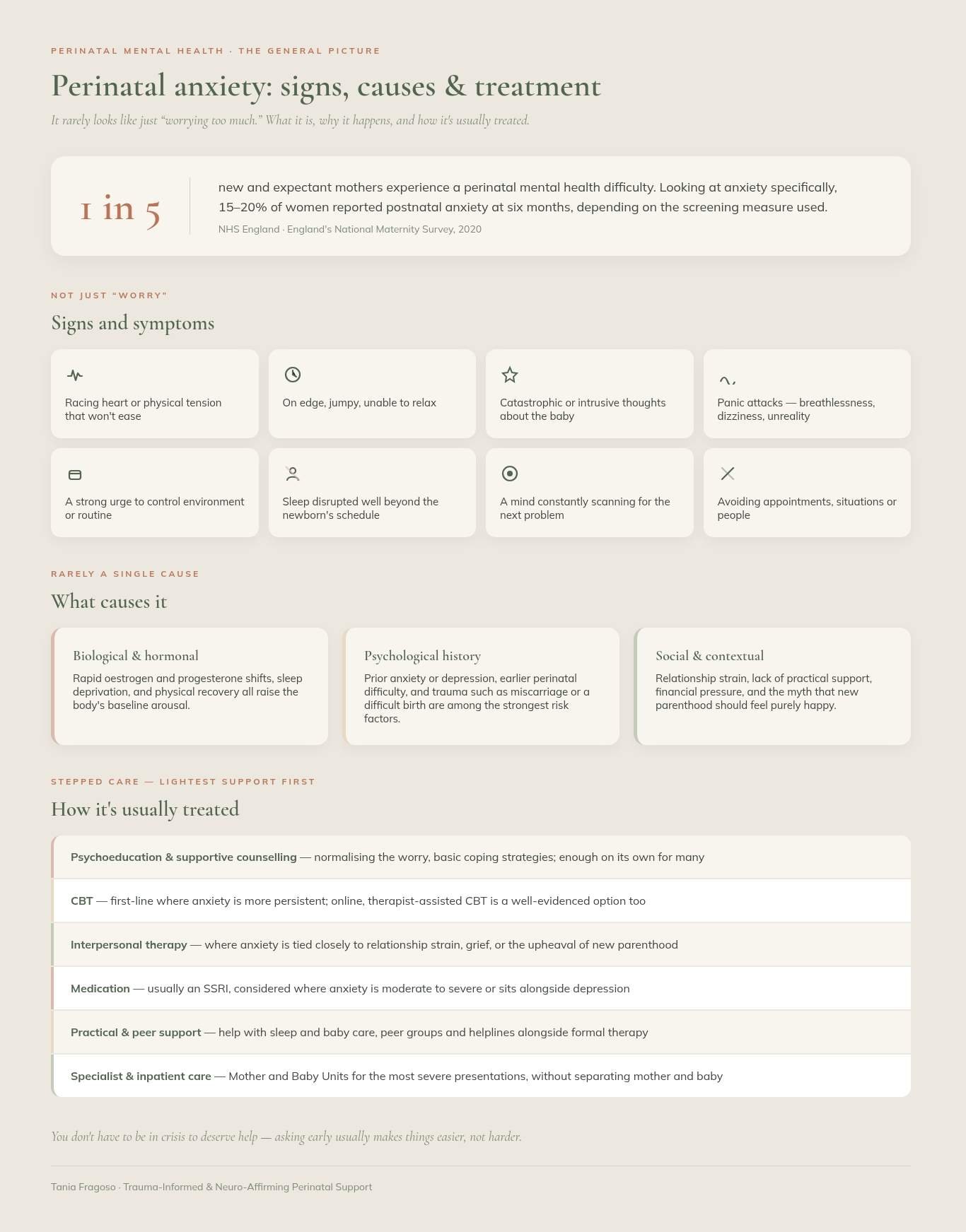
It's the period that runs from the start of pregnancy to the first year after giving birth, and feelings of anxiety are one of the most common difficulties within it. Up to a quarter of new and expectant mothers experience a perinatal mental health difficulty of some kind, according to NHS England. Looking at anxiety specifically, a 2020 survey of more than 4,600 women in England found that 15–20% reported postnatal anxiety at six months after birth, depending on which of three standard screening measures was used (analysis of England's National Maternity Survey).
Anxiety itself isn't a character flaw. It's what a nervous system does when it reads a situation as unsafe, whether or not the threat is immediate, and pregnancy and the postnatal period give it plenty to work with: hormonal change, disrupted sleep, pain, and a level of responsibility that can feel enormous.
Signs and symptoms of perinatal anxiety
It rarely looks like just "worrying too much." It's worth knowing the fuller range, because some of the most common signs are physical rather than mental.
A racing or pounding heart, or physical tension that doesn't ease even at rest
Feeling constantly on edge, jumpy, or unable to relax even when nothing is wrong
Catastrophic or intrusive thoughts about your baby's safety, the birth, or your ability to cope
Excessive worry about things going wrong, even without a clear reason to expect it
A strong urge to control your environment, routine, or the people around you
Panic attacks: a sudden rush of fear with a racing heart, breathlessness, dizziness, or a sense of unreality
Sleep disrupted well beyond what's expected from a newborn or pregnancy itself
A mind that won't stop scanning for the next problem, making it hard to concentrate on anything else
Physical symptoms such as nausea, tension headaches, or a churning stomach
Avoiding appointments, situations or people because the anxiety there feels unmanageable
Using clinical diagnostic interviews rather than self-report questionnaires, one study of pregnant women at a South London maternity service found around 17% met criteria for some form of anxiety disorder, generalised anxiety accounting for roughly 5% of that, with specific phobias and other presentations making up the rest (study).
What causes it
Experiencing perinatal anxiety, it's usually a culmination of several ordinary factors landing at once.
Biological and hormonal. Rapid shifts in oestrogen and progesterone across pregnancy and postpartum can trigger or worsen anxiety, especially where there's a prior history of it. Sleep deprivation, physical recovery from birth, and pain all raise baseline arousal in the body.
Psychological history. A personal or family history of anxiety or depression, earlier perinatal difficulties, and trauma, including miscarriage, stillbirth or a difficult birth, are among the strongest risk factors. Perfectionism and catastrophic thinking about a baby's health, or one's own adequacy as a parent, are common patterns underneath it.
Social and contextual. Relationship strain, a lack of practical support, financial or housing pressure, and experiences like a NICU stay or high-risk pregnancy all raise risk. So does the cultural expectation that new parenthood should be the happiest time, which makes it harder to admit when it isn't.
There's rarely a single cause. It's usually an accumulation of vulnerabilities meeting the intensity of the perinatal period itself. Left unsupported, antenatal anxiety has also been linked to poorer outcomes for both mother and baby, including a higher chance of anxiety continuing after birth and early difficulties with bonding, which is part of why catching it early is worth the effort (the same South London study referenced above).
Treatment for perinatal anxiety
Treatment options are rarely one-size-fits-all. Most health professionals follow a stepped-care model, starting with the lightest, least intrusive support and escalating only as needed, based on symptom severity, other factors, and the parent's preferences. This reflects UK clinical guidance directly: NICE recommends lower-intensity psychological support for mild to moderate symptoms, stepping up to CBT for more persistent or severe anxiety.
Psychoeducation and supportive counselling. For mild anxiety, this is often where treatment starts: someone explaining what's typical in pregnancy and postpartum, normalising the worry, and offering basic coping strategies. It's low-intensity by design, and for a lot of new parents, it's enough on its own.
Cognitive-behavioural therapy (CBT). Where anxiety is more persistent, CBT is usually the first-line psychological treatment, helping identify unhelpful worry patterns and gradually reduce avoidance. Therapist-assisted online CBT has also become a reasonably well-evidenced option where in-person therapy isn't practical.
Interpersonal therapy. This tends to be recommended instead of CBT where the anxiety is closely tied to relationship strain, grief, or the upheaval of becoming a parent.
Medication. Where anxiety is moderate to severe, or sits alongside depression, medication becomes part of the conversation, usually an SSRI antidepressant. Any decision involves a perinatal-aware discussion of risks and benefits for pregnancy and breastfeeding, alongside a clear plan rather than an abrupt stop to something that was already working.
Practical and peer support. Help with sleep, housework and baby care from a partner or family carries real weight, not just emotional value. Peer support groups and helplines, connecting with others who've been through the same thing, often complement formal therapy well.
Specialist and inpatient care. For the most severe presentations, Mother and Baby Units or specialist perinatal mental health teams allow intensive treatment without separating a mother from her baby.
Lifestyle and body-based approaches. Movement, sleep hygiene, structured routine, and techniques like mindfulness-based CBT or breathing work usually sit alongside formal treatment rather than replacing it. Where birth trauma is driving the anxiety specifically, trauma-focused therapies such as EMDR are often what's indicated.
If your experience doesn't quite match this picture
Everything above holds for most people. But if you're autistic, have ADHD, or have always suspected your mind works differently, several things layer on top of this general picture: sensory overwhelm, executive-function strain, and a nervous system that responds to these same causes with more intensity, which this piece doesn't cover. I've written about that in full in Perinatal Anxiety in Autistic and ADHD Mothers.
Frequently asked questions
Is perinatal anxiety different from antenatal depression?
They overlap, but they aren't the same. Depression tends to pull energy, interest and mood downward, while anxiety keeps the system switched on, restless and scanning for danger. Many people experience both at once, and you don't need to work out which label fits before you ask for help.
Can I have perinatal anxiety if I've never been anxious before?
Yes. Pregnancy and new parenthood put considerable load on the nervous system and emotional wellbeing. For some people, that's enough to bring anxiety forward for the first time, even without any prior history of it.
How long does perinatal anxiety usually last, and does it go away on its own?
For many people, it eases over weeks to a few months, particularly with the right support. Left unsupported, it can persist well into the second year and sometimes longer, especially where the underlying stressors, poor sleep, lack of support, and a birth experience that felt traumatic haven't been addressed. It's rarely a case of simply waiting it out.
What are the different types of perinatal anxiety, and how is it diagnosed?
Perinatal anxiety covers generalised worry, panic attacks, and for some women, perinatal OCD or a specific fear of childbirth known as tokophobia. There's no blood test for any of it. It's usually identified through a conversation with your GP, midwife or health visitor, sometimes alongside a short screening questionnaire.
When should I get professional help for perinatal anxiety?
Seek help when the anxiety isn't easing, when it's affecting your daily life or sleep, or whenever you simply feel you'd like support. You don't have to be in crisis to deserve help, and asking early usually makes things easier, not harder. Intrusive thoughts that frighten you, or any thoughts of harming yourself or your baby, are a signal to reach out straight away.
A gentle next step
If any of this rang true, you're not the only one who's felt it. When you're ready, you're welcome to book a discovery call through my Perinatal Counselling page, where we can talk about what support might look like for you.