Bonding With Your Newborn After a Difficult Birth: When the Rush of Love Doesn't Come
Bonding with your baby after a difficult birth experience is often slower than anyone prepares you for, and slow is not the same as absent.
I did not feel the rush. When my twin girls were born by caesarean in Portugal, someone had taken my glasses off and tied my hands to the bed, and the babies were held briefly above my head before they vanished from the room. Hours later, when I finally picked them up, I inspected their faces, looking for something that would confirm they were mine. Nothing came. I decided that this meant something permanent about the kind of mother I was going to be. It took me several years to find out that it did not.
This is for mothers who expected the rush and got something else instead. Numbness. Fear. Relief that it was over, followed by guilt about the relief. Or a flat, frightening blank where the feeling was supposed to be. It is written particularly for neurodivergent and highly sensitive mothers, because the explanations we are usually offered for a difficulty bonding rarely account for how our nervous systems actually work.

The rush of love is the most oversold moment in motherhood
We are shown one version of this. The baby is lifted onto the chest, the mother weeps, the connection is instant and total. That version does happen. It is just not the only one, and the silence around every other version does enormous damage.
Mothers describe that first meeting in far more varied ways. Recognition. Curiosity. Exhaustion. Disbelief. Protectiveness without any warmth attached to it. Or nothing much at all, which is the one nobody says out loud. They say the birth was "fine", they post the photo, and then they lie awake working out what is wrong with them. Usually nothing is wrong with them. What happened to them, on the other hand, may well have been significant.
What the research says about birth trauma and the maternal-infant bonding
The association between traumatic childbirth and difficulty in the bonding process is real, and it is measurable, but it is smaller and more recoverable than the guilt suggests.
A 2025 systematic review and meta-analysis of 22 studies with 9,472 participants found that ptsd symptoms following childbirth were associated with poorer mother-infant bonding: small-to-moderate for postpartum PTSD generally, moderate for traumatic birth experiences specifically. The authors noted that depression and general psychological distress may partly account for that relationship. A 2023 meta-analysis of 12 studies found much the same pattern, with a great deal of variation between studies.
A large 2022 review put childbirth-related PTSD at around 4.7% of mothers and significant post-traumatic stress symptoms at about 12.3%. Among women who described their birth as traumatic, roughly 19.4% went on to experience post-traumatic stress disorder. Those are separate things that get flattened together constantly.
The research describes increased risk, not a fixed outcome, and it consistently supports recovery once the right support arrives.
What seven years of practice has shown me about bonding after a difficult birth
Two things have held so consistently across seven years of this work that I have stopped being surprised by them: how a woman was treated during her birth matters more than what happened medically, and a difficult birth is not a sentence. I have been sitting with women through birth and its aftermath since 2019, first at the bedside as a doula, then in the counselling room, and now largely in birth debrief and in Birth trauma recovery work, across over 60 births attended and a hundred more hours of counselling and debrief sessions.
On the first: not a caesarean or vaginal birth, not whether it went to plan. What predicts an easier start is whether she felt informed, her birth plan was respected and if she felt physically safe while it was happening. I have watched women come through long inductions, forceps deliveries and emergency theatre and reach for their babies with complete presence, because someone explained things and asked for consent before touching her. I have also watched textbook births that leave a woman saying that they feel detached and flat, because they feel like it was something that happened to her as opposed to with her.
The second pattern is the one I actually want mothers to hold onto. When birth trauma occurs, this does not automatically translate into a sentence. In the counselling room I meet women months and sometimes years after the birth, still carrying a private conviction that they damaged something irreversible in the first hour, shortly after birth. In almost every case, what I find is a mother who has been doing the work of connection with their baby all along, in ways she has not been counting. She was in survival mode and mistook survival for indifference.
Difficulty with infant bonding is a symptom of overload. It is not a verdict on how much you love your baby.
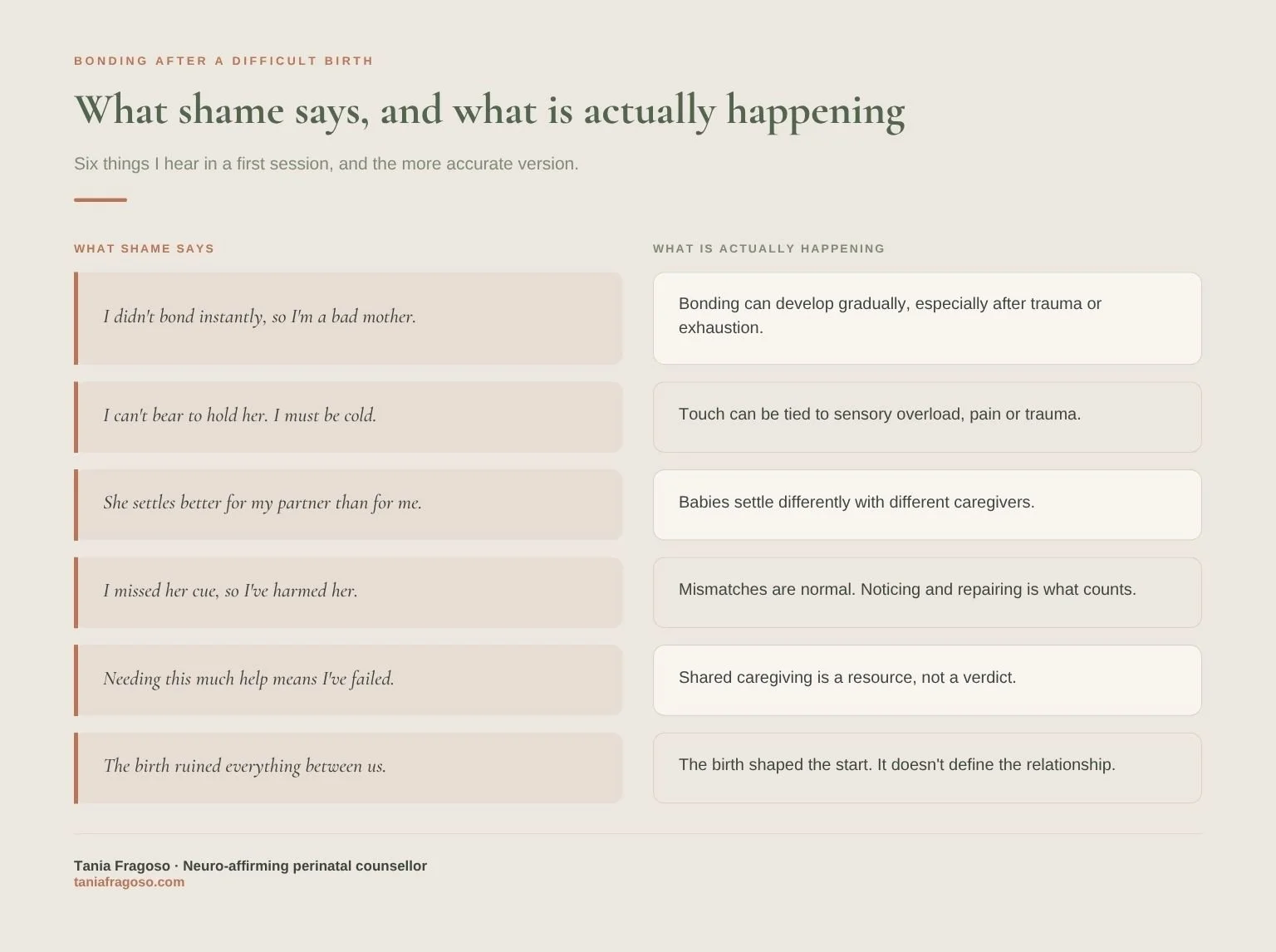
Why bonding can feel harder for neurodivergent mothers
For autistic, ADHD and AuDHD mothers, and for highly sensitive women, there is usually a second layer underneath the birthing experience itself.
Hospitals are a sensory assault. Strip lighting, alarms, unfamiliar smells, a rotating cast of staff, being touched constantly by people you have just met, information delivered verbally at speed that you cannot process, while you are in pain. If your nervous system already works hard to filter ordinary input, that can push you into shutdown before the baby even arrives. Shutdown looks like detachment from the outside. From the inside, it is protection.
Then there is the postnatal period itself. Interoception, the sense of what is happening inside your own body, is often less reliable in neurodivergent people, so hunger, exhaustion and panic go unnoticed until they are unmanageable. Sustained eye contact may be uncomfortable rather than soothing. Holding your baby for an hour might be fine but unbearable by the fourth. And a lifetime of masking means many of us perform the expected response instead of noticing the real one.
None of this indicates an absence of attachment. A 2023 qualitative study of autistic mothers titled "Yes, I can bond" exists precisely because the assumption that autistic women cannot bond with their baby has been so persistent and so wrong.
Bonding does not have one neurotypical appearance. It can look like learning your baby's patterns with forensic attention. Preparing bottles. Watching her sleep. Humming the same tune over and over because it soothes you and your baby. Advocating fiercely with a health visitor or GP. Looking at her face for two seconds, then away, then back. Those are mother-infant interactions that nurture and provide a secure attachment. They are just not the ones we often see portrayed in the media.
Bonding and attachment are not the same thing, and neither one is fixed
Bonding describes your feelings and your developing relationship towards your baby. Attachment describes your baby's longer-term relationship with you as a caregiver, built over thousands of ordinary interactions across the first years. They are related but not identical, and neither one is decided in a single hour.
I have to be careful here, because I love talking about secure attachment with the women I support and I have watched that conversation land as pressure more than once.
Attachment patterns are also not permanent. They shift with circumstance, with support, with repair, and with the relationships we have later in life. The idea that a difficult start locks a child into a fixed relational template is not what the research supports, and it is one of the more damaging things a frightened mother can read at two in the morning.
I carried that fear for a long time. I attributed almost every parenting struggle I had with my twins to their birth: my reactivity, their difficulties, the distance I felt in those early years. It is also one of the things that gets examined when you are assessed for ADHD or autism as an adult, because early adversity and neurodevelopmental difference can produce overlapping presentations, and a good assessor will want to untangle them. Trauma genuinely does explain some of it. It does not explain all of it, and my second daughter is the reason I know that.
My youngest daughter had an entirely different start. A caesarean again, but one where the doctor explained every step, my glasses stayed on my face, my husband never let go of my hand, and she never once left my bed afterwards. Our attachment has been secure from the beginning. She is also, quite clearly, neurodivergent herself.
Two children. Two completely different beginnings. Same underlying neurology running through the family. The birth affected the starting conditions for the relationship. It did not create who my daughters are, and it did not permanently break what I could offer them.
The golden hour matters, and it can also be extended
I will not tell you that baby skin-to-skin contact does not matter. It does. Done immediately after the baby is born, it can help with the production of oxytocin, which aids the birth of the placenta and the production of milk. It supports thermoregulation, provides an immunity boost and early physiological settling, and when it is safe and wanted it should be offered as standard. NICE postnatal care guidance recommends encouraging face-to-face interaction, skin to skin contact and responsiveness to infant cues, and explicitly names traumatic birth, physical recovery, fatigue and feeding concerns as things that can impact bonding.
What I want to correct is the idea that missing it is final. Caesarean recovery, haemorrhage, NICU admission, resuscitation, prematurity or simply being too dissociated to want to be touched can all interrupt those first hours. That interruption does not permanently determine your relationship with your baby.
The golden hour can be picked up later. Skin-to-skin at three weeks still does something, and so does a partner doing it while you rest and come back with more capacity. If direct skin contact is genuinely overwhelming for you, which for some neurodivergent mothers it is, there are adaptations rather than failures: the baby clothed against your chest, holding a hand or a foot, short predictable periods with a clear end, lower lighting, ear defenders.
Adapt the environment before you interpret your own behaviour as a relational failure. Most of the mothers I work with find that reordering does more than any bonding exercise.
What helps if you are having a hard time bonding with your newborn
The instinct, when bonding feels difficult, is to try harder. More holding, more eye contact, more time with your baby. For a nervous system still in survival mode, that usually increases distress and adds a fresh layer of evidence that you are failing. Reduce the pressure first, make one small thing possible, and treat the trauma as trauma rather than as a bonding deficit.
Make the step small enough that it feels almost too small
Effective ways to bond with a newborn, when you are this depleted, are the ones that take under two minutes:
🌿Sit near your baby for two minutes with another adult present.
🌿Notice one cue, a yawn, turning away, rooting, without trying to change it.
🌿Touch a foot or a hand, if that feels manageable today.
🌿Say one sentence out loud or hum for a few bars.
🌿Do one care task slowly, with support, and stop while it is still tolerable.
Afterwards, ask what you noticed and what was easier than expected, rather than whether you felt enough.
Fix the conditions before you work on the feelings
Practical relief matters as much as anything psychological. A mother in pain, badly slept and interrupted every twenty minutes, cannot reach warmth or curiosity, and no amount of bonding advice will change that. Protecting one period of sleep, treating pain properly and reducing visitors will often do more than any exercise on this list.
What your partner can do, for you and for the baby
Partners are usually given nothing to do except reassure you, which helps neither of you. There are two useful jobs.
The first is protecting your capacity. Someone who takes a night feed, manages the visitors, handles the appointments and guards one period of your sleep is doing bonding work, even though it does not look like it. You cannot be emotionally available on four hours of broken sleep.
The second is their own father-infant bonding. If you are breastfeeding, or if touch is currently more than you can manage, a partner doing skin-to-skin, bathing, settling and carrying is not a sign that you have been replaced. Babies form more than one secure relationship, and a second steady caregiver protects both of you. Fathers and partners whose bonding has felt hard after witnessing a frightening birth can also be struggling, and that goes unasked about almost universally. If that is happening in your house, it deserves the same attention as yours rather than being filed under supporting you.
When bonding has felt hard, the work includes your baby too
Almost all the support offered to a mother who is struggling to bond is aimed at the mother alone. Her mood, her anxiety, her birth story. That work matters and I do plenty of it, but on its own it often leaves the actual relationship untouched. Reviews of perinatal anxiety interventions have found something uncomfortable: approaches aimed only at the parent's anxiety tend to improve the parent's anxiety without necessarily changing anything between her and her baby.
Dyadic simply means two people. In this case, you and your baby work together rather than separately.
It changes the questions. Instead of asking whether you are bonding, which is unanswerable and makes most mothers feel worse, we look at the interaction as something the two of you are building between you. What is your new baby communicating through her movement, her gaze, her sounds, the way her body tenses or settles? Does she feel close? Does she feel calm? What do you notice, and what do you make of it? What happens when she becomes distressed? And how do the two of you find your way back afterwards?
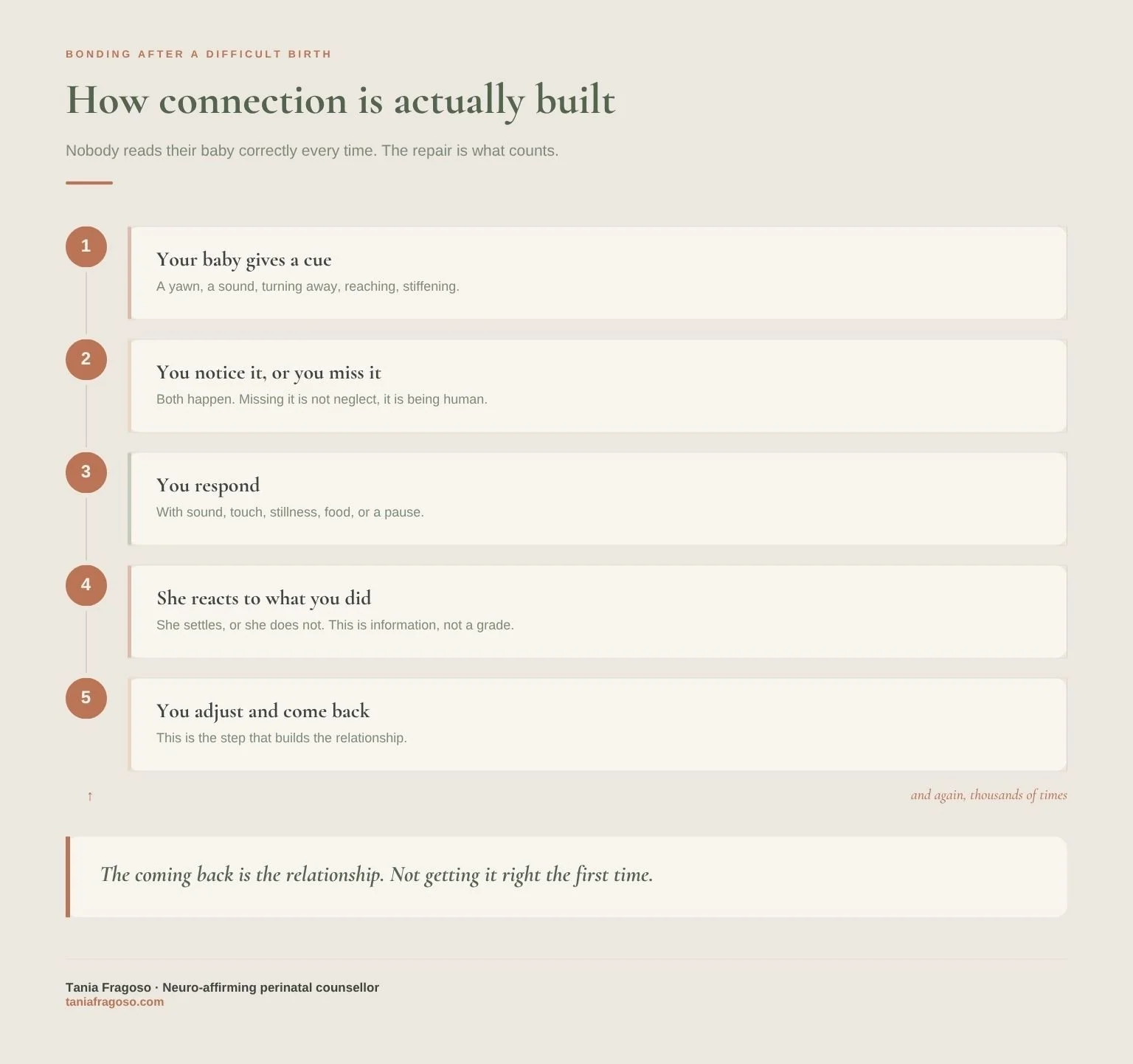
That last question is the one that does the most work. Nobody reads their baby correctly every time. What builds the relationship is the repair.
In practice, it means watching something completely ordinary. A feed. A nappy change. Settling her when she is grizzly. Then I point out what is already working, because you almost certainly cannot see it. You paused when she looked away. You lowered your voice, and she turned back towards you. Mothers who are convinced they cannot read their babies are usually doing all of this and discounting every bit of it. Then we choose one small adjustment to try, and only one.
The evidence is promising rather than settled, and I would rather tell you that than oversell it. A systematic review of 12 randomised studies found that interventions working with the infant's perspective, the mother's internal picture of her baby and the interaction itself showed real promise, with video feedback and interaction coaching among the components linked to better outcomes, though study quality varied. A 2015 randomised trial of 150 families after preterm birth found that Video Interaction Guidance improved sensitive behaviour and bonding, with the largest effects in mothers who had experienced experience ptsd after the birth.
For neurodivergent mothers, this approach tends to work better than talking about feelings, because it is concrete. "Relax and connect with your baby" is a useless instruction if you cannot reliably identify your own internal state on demand. "When her fingers splay and her gaze moves away, lower the sound and wait" is something you can actually do, and then observe, and then adjust. Rationalising is not a flaw to be therapised out of you. It is a route in.
What this is not: a test of whether you love your baby, a requirement to hold eye contact, a way of implying that the difficulty is your parenting, or a substitute for treating PTSD or depression when either is present. If the trauma is loud, the trauma gets treated. This work sits alongside that, not instead of it.
When to ask for more than reassurance
Normalising is not the same as minimising, and some of what I have described needs assessment rather than encouragement.
Speak to your GP, midwife, health visitor or a maternal mental health service if you are having flashbacks or intrusive images of the birth, ongoing avoidance of anything that reminds you of it, persistent numbness or a sense of unreality, panic, hypervigilance about your baby's breathing, or a low mood that is not lifting. If you are having frightening intrusive thoughts about harm coming to you or your baby, that is a reason to be seen quickly, and it is more common and more treatable than the shame around it allows women to believe.
Where PTSD is present, NICE recommends a trauma-focused psychological therapy such as trauma-focused therapy or EMDR. The trauma is treated directly, rather than asking you to perform more bonding while your nervous system is still braced for danger. When that happens, the relationship very often follows. This is the territory my birth trauma recovery work sits in.
Frequently asked questions about bonding after a difficult birth
Almost every question below has the same answer underneath it: bonding difficulty after a difficult birth is common, it is treatable, and it is not evidence of failure. These are the ones I am asked most often, usually in a first session and usually with an apology attached to them, when there is nothing to apologise for.
Is it normal if bonding feels difficult and doesn't happen immediately?
Yes. Feeling love immediately, gradually, intermittently or not at all in the beginning are all within the normal range. Bonding is a relationship that develops through repeated experiences of care, not a single event at birth that either succeeds or fails. The first feeling you have is not a reliable forecast of the relationship you will end up with.
What are the signs that I might be struggling to bond with my newborn?
You might feel numb or detached around your baby, find it hard to look at or hold her, feel that she belongs to someone else, or feel like you are performing motherhood rather than living it. Many mothers also feel intensely protective while feeling nothing warm. Struggling to bond usually means you are overloaded, unwell or unrecovered, not that you are uncaring.
How does birth trauma affect parent-infant bonding?
Trauma keeps the nervous system oriented towards danger, and that affects the parent-infant relationship in several ways at once. That can produce emotional numbing, intrusive memories, dissociation, hypervigilance and avoidance, all of which interfere with relaxed attention, touch and reading your baby's cues. Some mothers also find that the baby becomes a reminder of the birth itself. These are protective responses to what happened, not evidence of insufficient love.
Did missing skin-to-skin contact or the golden hour damage my bond with my baby?
No. Immediate skin-to-skin contact is beneficial when it is possible and wanted, but missing it because of surgery, medical complications, NICU care or your own distress does not permanently determine your relationship. There are thousands of opportunities to connect after birth, through feeding, holding, soothing, changing, talking and simply returning after a difficult moment.
How can my partner help me bond with our baby after a difficult birth?
By taking on caregiving so you can rest and come back with more capacity, and by doing skin-to-skin themselves, which supports the baby without asking anything of a body that is still recovering. Ask them to protect one period of your sleep, manage visitors and learn your baby's cues alongside you. A baby can have more than one secure relationship, and shared caregiving protects both of you rather than proving you have failed.
Why does bonding with a newborn matter, if it is not a test?
It matters because a baby's early experience of being noticed, comforted and responded to shapes how safe the world feels to her, and because feeling connected to your baby makes an exhausting job survivable for you. Both of those are real. What they are not is a deadline. The relationship is built through repeated ordinary care across months and years, not proved or lost in the first hour, which is precisely why a slow start is not the emergency it feels like at the time.
What is dyadic interaction coaching?
It is short-term work with a parent and baby together, rather than with the parent's symptoms alone. A practitioner observes an ordinary moment of caregiving, points out the small things that are already working, and helps you practise one adjustment, such as waiting a few seconds longer or lowering the stimulation before you respond. It is used after a frightening birth, a neonatal admission, a long separation or a period of postnatal depression, and it is usually more useful than being told to spend more time with your baby.
When should I seek professional help for difficulty with my baby?
Talk to your GP, health visitor or a perinatal mental health professional if the difficulty bonding with your baby has persisted beyond the first few weeks, or if you are struggling with any mental health issue. If you have PTSD symptoms such as flashbacks or avoidance, if your mood is persistently low, or if you are frightened by your own thoughts. You do not need to be in crisis to be entitled to support, and earlier help generally means a shorter recovery.
If the birth is still sitting between you and your baby
Bonding with your newborn after a difficult birth is not a test you have already failed. It is a relationship that is still being built, and it can be built from wherever you are standing now, including from a starting point of numbness, guilt and exhaustion.
If your birth is still taking up more space than you want it to, a birth debrief is a contained way to look at what happened, with someone who will not rush you or ask you to be grateful that the baby is healthy. Where bonding is part of what you are carrying, we can work with the two of you rather than only with the birth.
You are not too late. I was several years late, and my daughters are fine.