Late ADHD Diagnosis in Women: The Grief Nobody Prepares You For
Most women who are diagnosed with ADHD as adults are diagnosed later in life than men, and for many, motherhood is the moment it finally surfaces, not childhood, not early adulthood.
I was one of them. I didn't get my AuDHD diagnosis (I am both Autistic and ADHD, though for most of my adult life I had no language for either) in my twenties, when I was struggling to adapt to a new country. I didn't get it in my first pregnancy, when I fainted on the London Underground more than once because I couldn't listen to what my body was telling me it needed.
I got it in my early forties, after two traumatic births, years of postnatal depression, and a burnout diagnosis that I kept mistaking for something I should simply be stronger than, and a slow, humiliating realisation that the coping strategies which had carried me through decades of "high-functioning" life had finally run out of road.
If you're reading this because something similar has just happened to you, because a diagnosis has landed in the middle of motherhood rather than before it, I want you to know first that you are not late. You are exactly on time for the moment your nervous system could no longer hide what it had been carrying.
Why ADHD in women is so often diagnosed later in life
The research is unambiguous on this point, even if the lived reality took decades to catch up with it. A 2023 study in the Journal of Child Psychology and Psychiatry, drawing on health records for over 16,000 people diagnosed with ADHD in Sweden, found that women receive a diagnosis nearly four years later than men on average, at 23.5 compared with 19.6, despite having just as much contact with health services in the years before. A systematic review of ADHD in adult women adds the missing piece: this delay isn't just later timing. Women are often misdiagnosed with anxiety or depression, although they often can co-exist; addressing the underlying ADHD through a different medication and treatment would yield different results. Instead, women take a very different route: medication that often doesn't work and therapies that don't fit, perpetuating feelings of shame and the sense that they are failing in life. These misdiagnoses don't translate to just a handful of women slipping through the cracks. It's a pattern, and now it's a measured one.
The same pattern holds for autism. Camouflaging, consciously or unconsciously masking autistic traits to move through a world built for a different kind of brain, has been shown to predict age at diagnosis more strongly in women than in men. That helps explain why so many autistic women, and so many AuDHD women like me, aren't identified until well into adulthood.
None of this was ever a personal failing, though it took me a long time, and a lot of grieving and acceptance, to believe that about myself.
If you spent your twenties and thirties wondering why everyone else seemed to manage life with less visible effort, why you were "so bright but disorganised," why you could hold a demanding job but fell apart as soon as you walked in the house, leaving you with no capacity for anything else, that wasn't a character flaw you needed to work harder to fix. It was an undiagnosed neurotype, doing its best inside systems that were never built to recognise it in you.
How this looks different from ADHD in men
Part of the reason it took so long is that the diagnostic criteria most clinicians were trained on came from how Attention Deficit Hyperactivity Disorder and autism present in men and boys: visible hyperactivity, obvious disruption, externalised behaviour. Girls and women more often internalise. What gets missed in a ten-minute appointment isn't the absence of a condition. It's a presentation nobody was trained to look for.
Many women with undiagnosed ADHD become extraordinarily skilled at masking. We watch. We mirror. We over-prepare so that nobody sees the complex systems we have built that hold the performance up. I built an entire professional life in corporate banking on exactly this kind of scaffolding, and it worked, right up until pregnancy and birth trauma took it away and left me with no explanation for why I was suddenly, catastrophically, not coping.
What masking actually costs
ADHD masking isn't a discreet, occasional adjustment. It's a full-time, unpaid, exhausting job that runs underneath every other job you're doing. A 2025 study of 28 late-diagnosed women, published in Scientific Reports, found this pattern showing up at every life stage: participants described low self-esteem rooted in childhood, carried the same guilt and shame into adulthood, and traced both straight back to the years spent without a diagnosis to explain what was happening.
For many women, the presentation is inattentive ADHD rather than hyperactive, the version that doesn't get noticed because it doesn't disrupt a classroom or a meeting. It looks like quietly double-checking your every move, getting lost in your thoughts during a meeting and only returning when you're asked if you have anything to add; it's the endless started projects that never get to have an end, or the inability to manage your day-to-day admin and finances. It looks like reading the same paragraph of a work email four times because your attention keeps sliding off it, then staying up late to finish the work everyone else finished on time. It looks like being told you're "such a perfectionist" and actually believing that is true about yourself, when what's actually happening is that finishing feels physically impossible unless the thing is right, and knowing when something is "right enough" is exactly the executive function skill that isn't reliably available to you.
Why so many women with ADHD seem quiet
Are women with ADHD typically quiet, withdrawn, well-behaved? Often, yes, but not because that's who they are underneath. Staying quiet is the mask. Autistic masking works the same way, just with a different toolkit: rehearsing conversations in advance, forcing eye contact that costs real effort, copying other people's expressions so nobody notices you don't process a room the way they do. Two women can look equally composed in the same meeting. What differs, invisibly, is how much of themselves each one had to spend to get there.
The emotional dysregulation associated with ADHD compounds this. It isn't just difficulty with organisation or time. It's a nervous system that registers frustration, rejection, and overwhelm at a volume other people don't seem to experience, with far less capacity to regulate the response before it shows up on your face, in your voice, in the way you snap at someone you love and then spend the rest of the day quietly hating yourself for it, and replaying in your mind months and sometimes years after it passed.
Living with undiagnosed ADHD, or an undiagnosed AuDHD profile, for most of the women I work with, means living with a low background hum of shame that has no name yet. You know something is different. You just don't have the word for it.
Why motherhood is so often the moment it surfaces
If masking is a job, motherhood is the point at which most women lose the resources to keep doing it.
Pregnancy and the postpartum period bring the single largest hormonal shift most women's bodies will ever go through, layered on top of catastrophic sleep deprivation and a total collapse of the routines, quiet, and control that many undiagnosed ADHD women have spent years building precisely because they need them to function. The executive function scaffolding that held everything together, the calendars, the reminders, the carefully protected pockets of solitude, doesn't survive a newborn. But there's rarely room to notice that in the first year. You're in survival mode, and survival mode has its own kind of adrenaline.
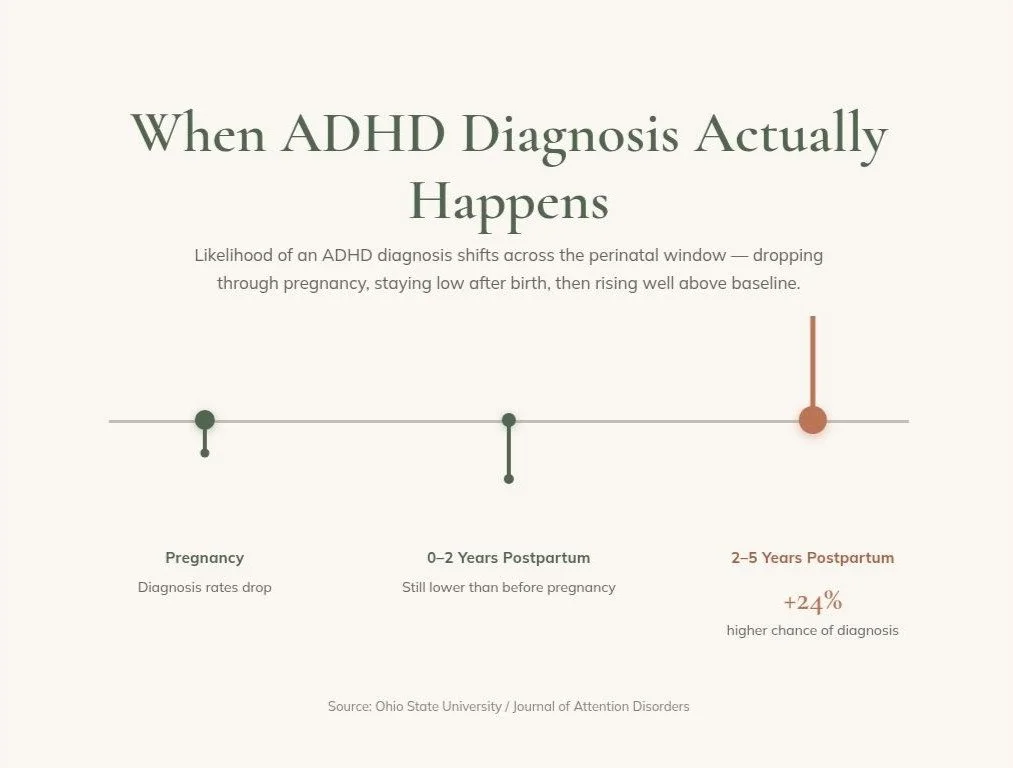
This isn't a coincidence or a personal weakness. Research tracking hundreds of thousands of births found that ADHD diagnosis rates actually dip during pregnancy and the first two years after birth, then rise sharply once children are between two and five, when women have around a 24% higher chance of being diagnosed than they did before pregnancy. It's rarely the newborn stage that finally surfaces it. It's the years after, once the adrenaline fades, the mental load of an older toddler sets in, and there's just enough space to notice that something underneath has been struggling the whole time.
I think about this often in relation to my own births. My first labour, in a country that was my own but didn't feel like it, with a husband commuting back and forth and a body I didn't yet know needed different things than the bodies around me, I had no language at all for what was happening to my nervous system, only the growing, humiliating sense that I was failing at something other women seemed to move through more easily. It would be years before I understood that my sensory sensitivities, my need for routine, my particular way of processing an unfamiliar system, weren't a sign that I was failing. They were just how my brain works. The diagnosis, when it eventually came, didn't change what had happened. But it changed how I understood it, and how I finally became kinder to the way I spoke to myself.
The grief nobody prepares you for
This is the part of a late diagnosis that gets the least airtime, and I think it deserves the most.
An adult ADHD diagnosis is rarely simple relief, though relief is real and often overwhelming in the first days. It's grief too. In that same 2025 study of late-diagnosed women, a quarter of participants described the feeling in almost exactly these terms when asked to reflect on how things might have gone with an earlier diagnosis: hurt, loss, being cheated out of something. Grief for the years spent not knowing: the exams that could have gone differently, the relationships strained by traits nobody had a name for, the sheer volume of energy spent white-knuckling through ordinary life while everyone around you assumed it came naturally. Grief for the mother you might have been to your older children, or your first pregnancy, had you had this understanding sooner. And a quieter, harder grief still: mourning the version of yourself you spent years believing you were failing to become, when you were never failing. You were simply unsupported.
I recognise this pattern in myself and in the women I sit with. A diagnosis in the middle of motherhood rarely arrives as pure good news. It arrives as good news wrapped around a genuine loss, and both things are allowed to be true at once. You're allowed to feel relieved and robbed. Glad you finally know, and furious that it took this long.
So few people say this to women in your exact position: the grief isn't a sign that something is wrong with how you're processing the diagnosis. It's the appropriate response to discovering, later than you should have, that your brain was never the problem. The systems around you weren't built to see it and support it.
What actually helps
I want to be honest about scope here, because vagueness is its own kind of harm. If you suspect undiagnosed ADHD, autism, or an AuDHD profile, and haven't yet had a formal assessment, that conversation belongs with your GP or a qualified assessment service, not with a blog post, however well-intentioned. What I can offer sits downstream of that: support with the emotional and identity work that a diagnosis, whenever it lands, sets in motion, particularly when it lands inside the demands of early motherhood, alongside birth trauma, or on top of burnout that's already been misread as ordinary new-mother exhaustion.
Getting the right support after a late diagnosis, in my experience, rarely means a single conversation or a neat resolution. That matches what the research shows too: the same women who described guilt and shame before diagnosis went on to describe the diagnosis itself as revelatory, something that improved their self-esteem and made life feel more worth living, once they had support in place to make sense of it. It means finding people, professionals, and ideally other neurodivergent mothers too, who understand that your ADHD isn't a deficit to be managed into invisibility. It means grieving what needs grieving without being rushed past it. And it means, eventually, building a version of motherhood that works with your brain rather than constantly against it.
You don't have to work all of this out alone, and you don't have to have a tidy narrative about your diagnosis before you're allowed to ask for help.
If any of this is landing and you'd like to talk it through, that conversation is available whenever you're ready for it, not before.
Frequently Asked Questions
The questions below come up often in conversations I have with women navigating this, so I've tried to answer them as directly as the rest of this piece.
-
In this age group, ADHD often surfaces around a major life transition, frequently pregnancy, postpartum, or a return to work after leave, when existing coping strategies stop being sufficient. A UK study of women diagnosed in adulthood, aged between 19 and 56 at interview, found the same story across the group: years of misattributed struggle before anyone considered ADHD as the explanation. Common signs include a sharp increase in forgetfulness, difficulty regulating emotion under sleep deprivation, sensory overwhelm that wasn't previously a problem, and a growing sense of falling behind despite working harder than ever.
-
Yes, and this is precisely why so many go undiagnosed for decades. Research on ADHD in girls has found that impairment levels can be just as high, or higher, than in boys, while referral for assessment happens far less often. Many women with ADHD build careers and lives that look, from the outside, entirely successful, often through significant, invisible over-effort. Success is frequently the mask, not the evidence against diagnosis.
-
Relief and grief typically arrive together. A 2025 study of 28 late-diagnosed women found guilt, shame, and negative self-perception were the dominant emotional pattern before diagnosis, giving way to relief and improved self-esteem afterward, alongside grief for the years lived without an explanation. Both the relief and the grief are normal, and neither cancels the other out.
-
Research tracking large numbers of births has found that ADHD diagnosis rates dip during pregnancy and the first two years postpartum, then rise by around 24% once children reach two to five years old, when the cumulative mental load of parenting an older toddler tends to outstrip whatever coping strategies were holding things together before. It's also common for mothers to seek their own assessment only after a child of theirs is diagnosed, recognising the same patterns from the other side.
-
Formal ADHD assessment and any decisions about treatment sit with a GP or specialist ADHD service. Alongside that clinical pathway, many women benefit from support that focuses on the emotional and identity impact of a late diagnosis, particularly where it intersects with birth trauma, burnout, or the demands of early motherhood.