If you are struggling after birth in the Netherlands, start with your huisarts (GP): they can offer sessions with the practice’s mental health nurse (POH-GGZ) at no cost to your eigen risico, or refer you to a psychologist.
Most of my years as a mother have been in countries that weren’t my own. I remember how much heavier everything felt when the language and the unwritten rules belonged to someone else, and how hard it was to know who to ask when I was not coping. I remember how much courage I had to gather to walk into that GP appointment and fill in the Edinburgh Postnatal Depression scale, as truthfully and honestly as I could, feeling scared of how I would be judged as a mother and if they would question if my daughters were safe.
For seven years I have supported mothers in the Netherlands through pregnancy, childbirth and the months after. Many of them were a long way from family. The same question comes up again and again, sometimes through a text message a couple of days after childbirth, sometimes through an informal and relaxed catch-up, sometimes said in a lower tone of voice as if it's a secret shared, sometimes fighting the tears back: "Is this normal, and who do I even talk to?"
If you are reading this at 3 am with a baby asleep on your chest, I want to make this part easier. The Dutch system does have support for postpartum mental health. It just isn't always explained well, and it is rarely explained in English. This guide takes you through it step by step: who to talk to, what to say, what it costs and what you can do while you wait.
Around 1 in 10 women experience depression after giving birth (University of Twente). You are not the only one, and asking for help is not an overreaction.
Postpartum mental health: what is normal and what is not
Baby blues, postpartum depression and other mental health problems after birth
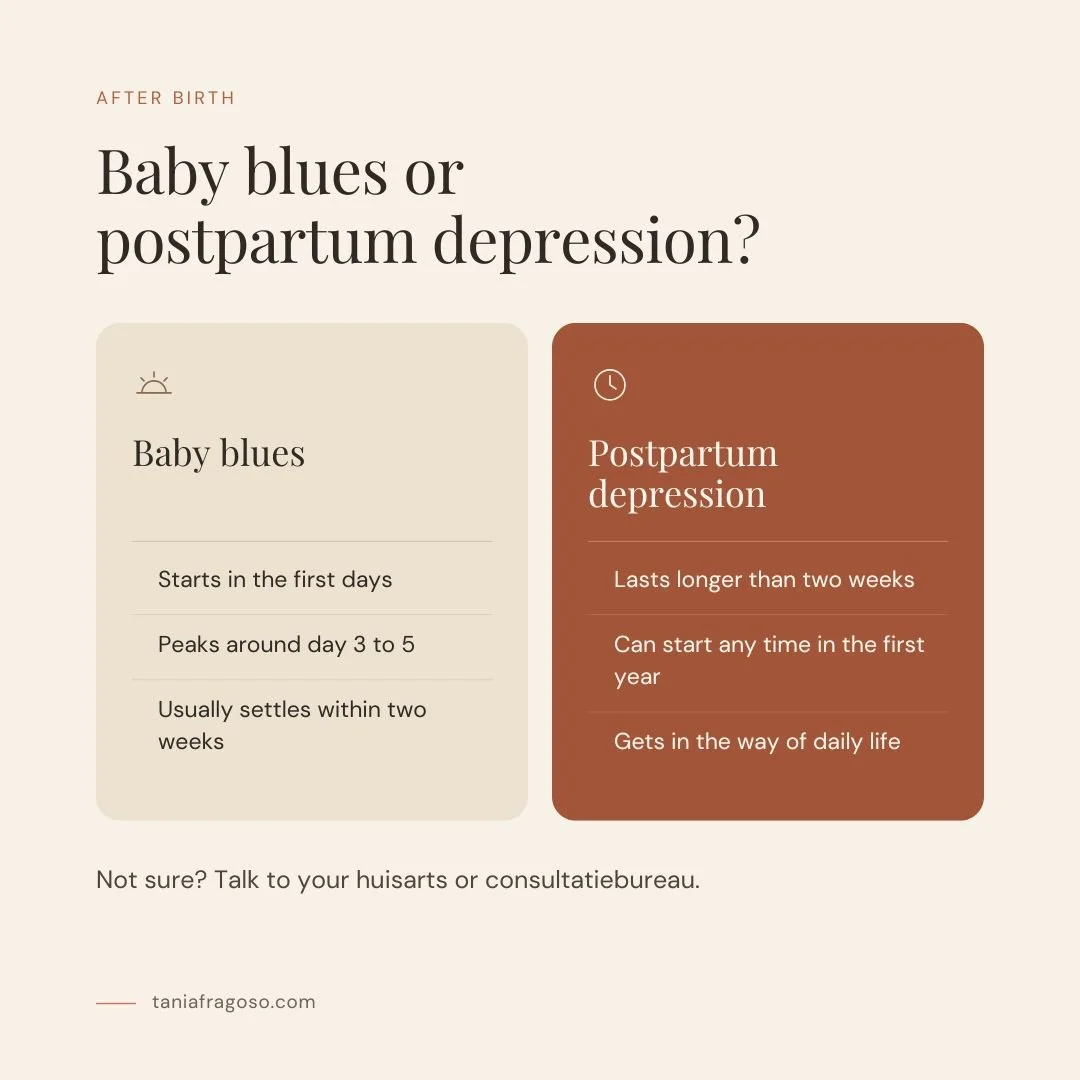
In the first days after birth, many mothers feel tearful, raw and overwhelmed. This is often called the baby blues. It tends to peak around day three to five and usually settles within two weeks.
Postpartum depression is different. It lasts longer than two weeks, it can start any time in the first year, and it gets in the way of daily life. Postpartum anxiety, intrusive thoughts and birth-related trauma are just as common, and they often sit alongside depression or show up without it.
Symptoms and risk factors for postpartum depression and anxiety
Low or flat mood on most days, or feeling numb and disconnected from your baby
Constant worry, racing thoughts or panic attacks
Frightening, unwanted thoughts about something happening to your baby
Being unable to sleep, even when your baby is asleep
Irritability or sudden rage that feels out of character
Flashbacks, nightmares or dread when you think about the birth
A persistent belief that you are failing as a mother
If you are autistic or have ADHD or identify as HSP, these signs can look different. Burnout, shutdowns, sensory overload, and suddenly losing the ability to mask can all be part of the picture, and they are easy to miss in a ten-minute appointment.
Extra risk factors when you are mothering far from home
Some things make postpartum depression more likely: a history of depression or anxiety, a difficult or traumatic birth, a baby who needed intensive care, and very little sleep for a very long time.
Being far from home adds its own weight. Research on migrant mothers in the Netherlands points to recent arrival, limited social support and strain in the relationship with a partner as key risk factors (University of Groningen). Researchers at VU Amsterdam also describe the loss of familiar postpartum rituals and traditions as an added stressor.
In many cultures, a new mother is cared for by the women around her for weeks. Here, your kraamzorg week ends, your partner goes back to work, and the people who would have fed you are a flight away. Missing that care makes complete sense. It is a real gap in support.
How perinatal mental health issues can impact the mother, the baby and the family
The impacts go beyond the mother's mood. It can show up through physical symptoms, affect energy levels, irritability, worry, and feelings of guilt, making parenting much more challenging; it can also affect the mother-baby bond and the relationship, as mothers often feel less emotionally available to connect with their partners.
It does not mean that a mother who is struggling with mental health issues is incapable of caring for and loving her baby; she often does. It can just take more out of her, with moods that shift in ways she can’t control.
Early recognition, compassionate support by a professional, or support from family and friends can interrupt the cycle and support recovery and reconnection.
Postpartum mental health services in the Netherlands, step by step
The Dutch system runs through your huisarts (GP). Almost everything starts there, but there are people who can help you get to that point.
Step 1: Talk to your consultatiebureau, verloskundige or kraamzorg
The consultatiebureau (child health clinic) sees you and your baby regularly in the first year. Many now ask mothers to fill in the Edinburgh Postnatal Depression Scale (EPDS), a ten-question check-in on how you have been feeling. Trimbos guidance recommends offering it at around one month and at least twice more after that (Trimbos). The questionnaire exists in many languages, so you can ask for it in English.
You can also raise it with your kraamverzorgende during the kraamweek, or with your verloskundige (midwife) at your six-week check. This is part of their job, and you are not wasting their time. They can help you put words to it and point you to your huisarts.
If you already struggled with your mental wellbeing in pregnancy, ask whether there is a POP-poli near you. These are hospital clinics where psychiatry, obstetrics and paediatrics work together, such as the one at MMC Veldhoven near Eindhoven.
You can also take the Edinburgh questionnaire here in English, in your own time, before your appointment.
Step 2: Prepare for your huisarts appointment
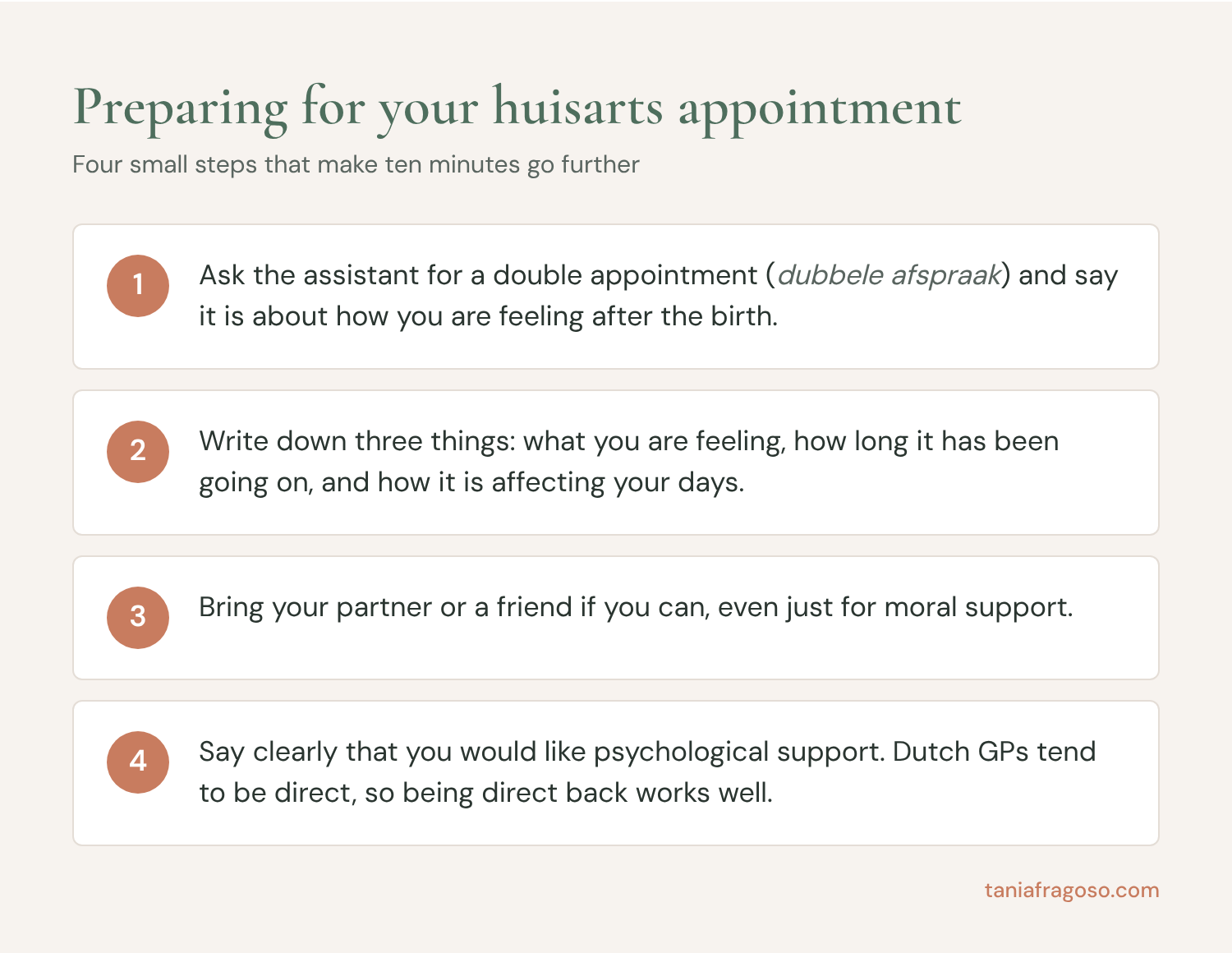
A standard GP appointment is about ten minutes, and it goes quickly when you are tired and speaking in a second language. A little preparation helps.
Ask the assistant for a double appointment (dubbele afspraak) and say it is about how you are feeling after the birth.
Write down three things: what you are feeling, how long it has been going on, and how it is affecting your days. If you have done the online Edinburgh questionnaire, print your result and bring it with you.
Bring your partner or a friend if you can, even just for moral support.
Say clearly that you would like psychological support. Dutch GPs tend to be direct, so being direct back works well.
If words fail you in the room, you can read this out or show it on your phone:
"Since having my baby, I have been struggling with low mood, anxiety and exhaustion for [how long]. It is affecting my ability to look after myself and my baby. I would like to talk about mental health support, ideally in English. Can I see the POH-GGZ, and what are my options for a referral?"
Step 3: What the POH-GGZ can offer
Most GP practices have a POH-GGZ, a mental health practice nurse or practitioner who works inside the practice. You can usually see them sooner than a psychologist, and the sessions are short-term and practical.
The POH-GGZ is part of GP care. That means it is covered by your basic insurance and does not come out of your eigen risico, your annual deductible (poh-ggz.nl). Not every POH-GGZ works in English, so it is worth asking when you book.
Step 4: Referral to primary or secondary mental health care
If you need more than the POH-GGZ can offer, your huisarts can refer you to the GGZ (mental health care). There are two main levels:
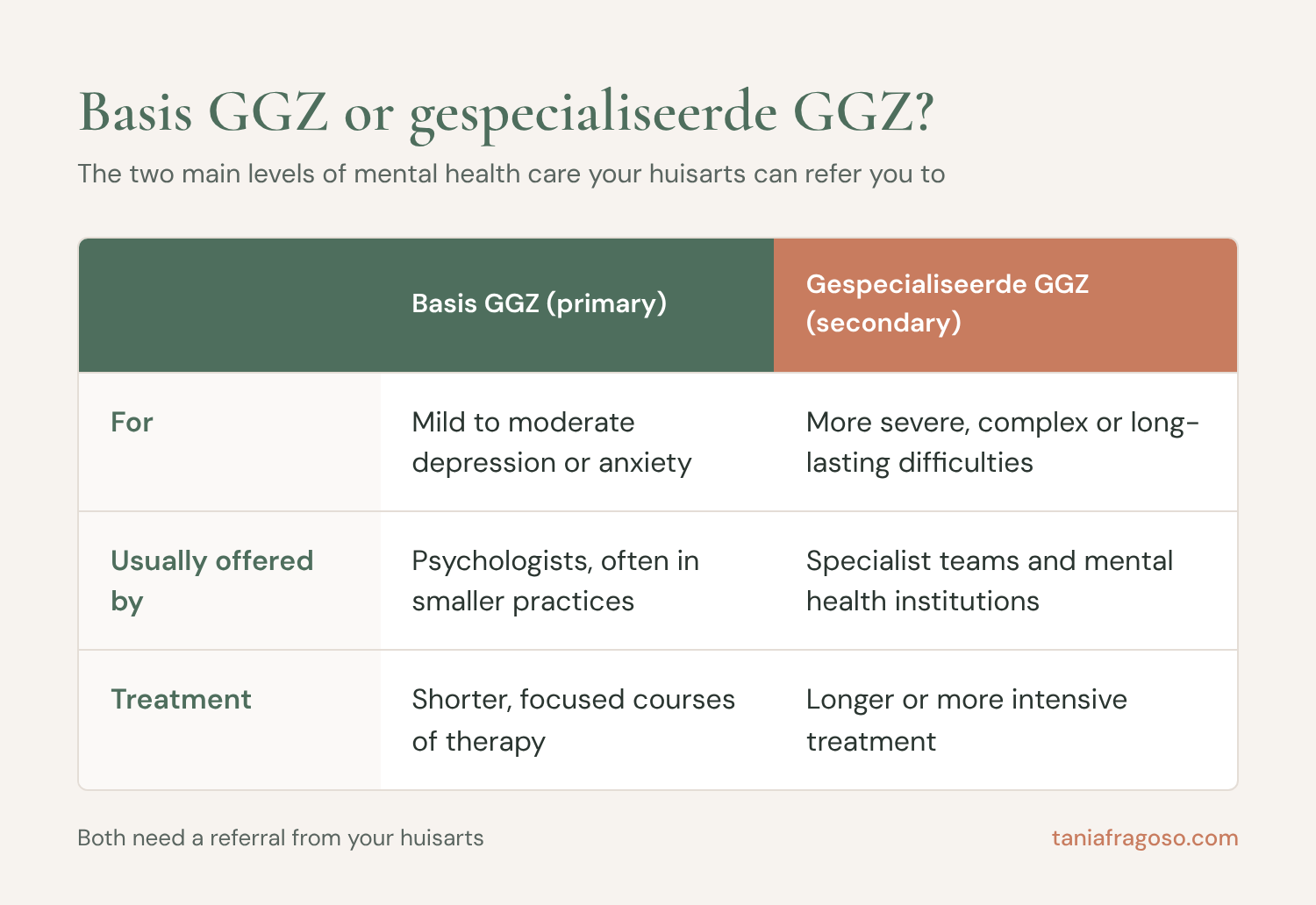
Ask your huisarts to mention in the referral letter that this is postpartum and that you would prefer an English-speaking clinician. It is also worth checking whether the practice is contracted by your insurer, as this affects how much you get back.
Does health insurance cover mental health care after giving birth?
Yes, in most cases. Mental health care with a referral is part of the Dutch basic insurance (basisverzekering), so every insurer covers it, whether you are with Zilveren Kruis, CZ, VGZ or anyone else.
What you pay depends on where you are seen:
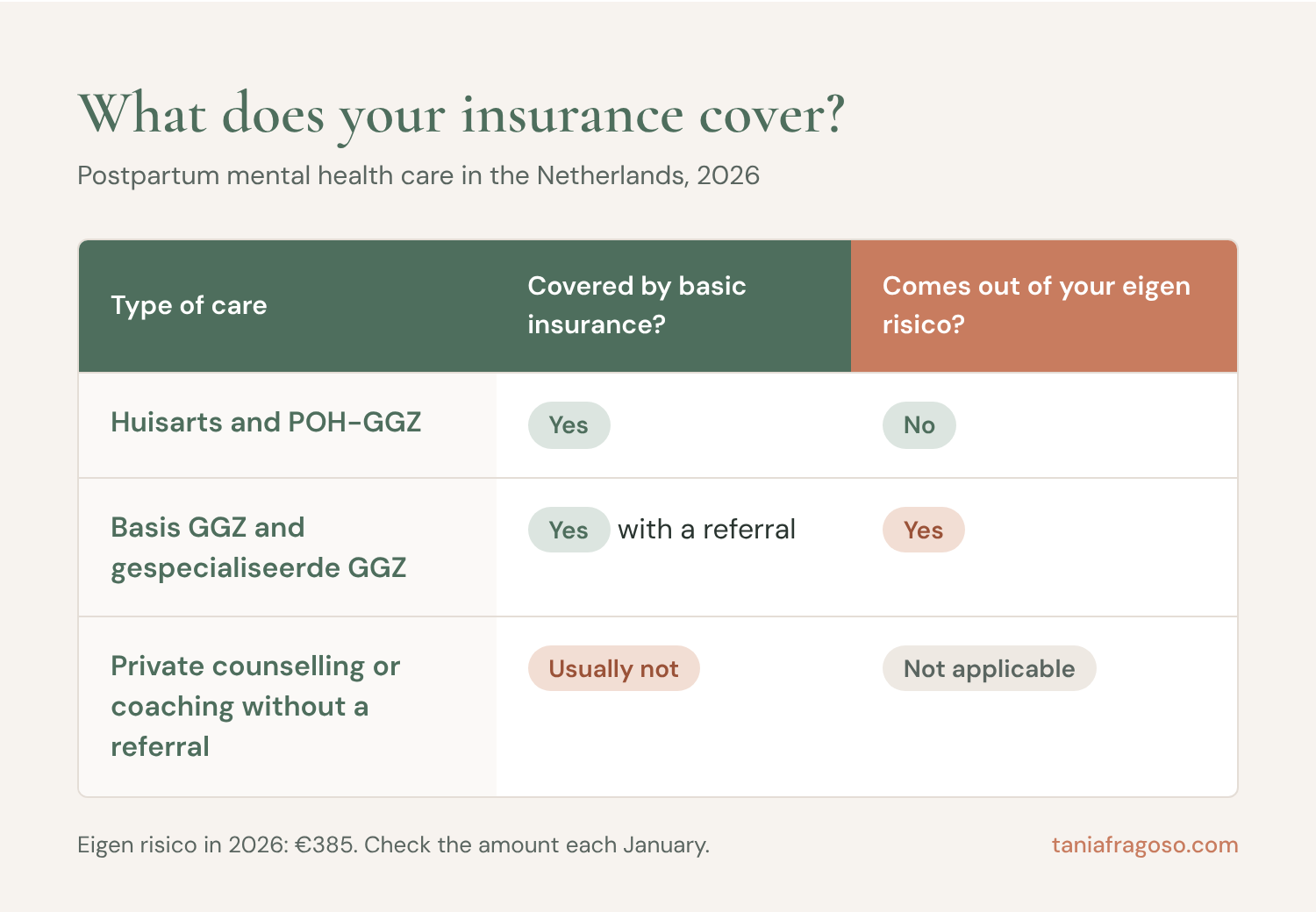
The eigen risico is €385 in 2026 (Consumentenbond). The government has announced changes from 2027, so check the amount each January. If you have had other care this year, such as hospital appointments or medication, you may have used some or all of it already.
Two more things are worth knowing. With a natura policy, you get full reimbursement only from providers your insurer has contracted. With a restitutie policy, you have more freedom to choose. Private perinatal counselling, coaching and doula support are not part of the basic package, and supplementary policies vary a lot, so look at your own aanvullende verzekering before you assume either way.
GGZ waiting lists: what to do while you wait
On paper, the Dutch standard (the Treeknorm) says you should have an intake within four weeks of registering and start treatment within fourteen weeks (Consumentenbond). In practice, many people wait longer. The Dutch Healthcare Authority (NZa) counted almost 109,000 waiting places in October 2025, with basis GGZ the closest to meeting the standard (GGZ Totaal).
When you are already depleted, a long wait can feel like being told to cope alone. A few things can shorten it or make it more bearable:
Call your insurer and ask for wachtlijstbemiddeling (waiting list mediation). Insurers have a duty of care and can help you find a practice with a shorter wait.
Keep seeing the POH-GGZ while you wait. You don't have to choose one or the other.
Tell your huisarts if things get worse. Your situation can be reassessed and the referral marked as more urgent.
Make the days smaller. Pick one thing that matters today, eat something every few hours, and let the rest wait. Exhaustion makes every decision harder, especially if you have ADHD or are autistic.
Ask for specific help. "Can you bring dinner on Thursday?" is far easier for people to say yes to than "let me know if you need anything".
Finding an English-speaking psychologist or therapist
Talking about the most vulnerable months of your life in your second or third language is exhausting. You are allowed to want to do it in English.
Start by asking your huisarts which practices they refer to in English. You can also call your insurer and ask which contracted psychologists offer therapy in English, especially if you have a natura policy. In larger cities and around Eindhoven, many practices already work with international families.
Online perinatal mental health care
Many basis GGZ practices now offer some or all sessions by video. With a newborn, not having to get out of the door can make the difference between going and cancelling. Online care is covered in the same way as in-person care, as long as the practice works with your insurer.
When private perinatal counselling is the right route
Private counselling does not need a referral, and there is usually no waiting list. For some mothers, that is the deciding factor. Others choose it because they want someone who specialises in the perinatal period, birth trauma or neurodivergence, and who understands what it is like to become a mother far from home.
It can work alongside the GGZ route too: a place to be heard while you wait, or a space for the parts of matrescence that don't fit a diagnosis. It is not a replacement for medical care if you have severe depression, thoughts of harming yourself, or symptoms of postpartum psychosis.
This is the work I do. I offer perinatal counselling and birth debriefs in English, online and in person in Eindhoven, with a trauma-informed and neuro-affirming approach. Private sessions are paid for yourself, as they are not part of basic insurance.
Finding appropriate perinatal mental health care in a crisis
Some situations can't wait for an appointment. Get help today if you have thoughts of ending your life or harming yourself or your baby, or if you or the people around you notice confusion, extreme agitation, not sleeping at all, or beliefs and perceptions that don't feel like you. These can be signs of postpartum psychosis, which is rare and treatable, and needs urgent care.
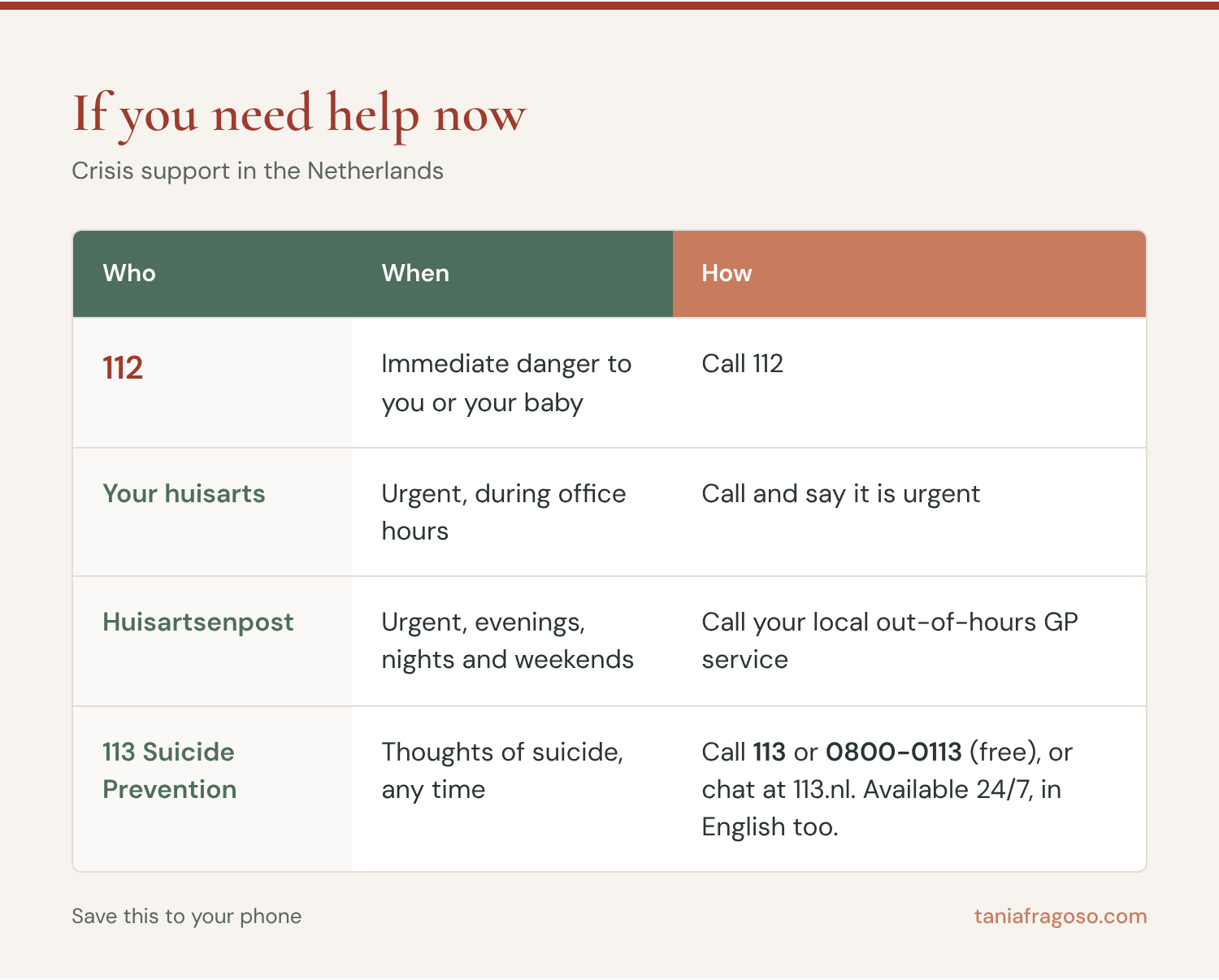
Crisis numbers in the Netherlands: 112 for emergencies, and 113 or 0800-0113 for suicide prevention
Frequently asked questions
Here are short answers to the questions mothers ask me most often about postpartum mental health in the Netherlands.
How are postpartum mental health problems identified and treated in the Netherlands?
Start with your huisarts. They can offer sessions with the POH-GGZ in the practice or refer you to a psychologist. Your consultatiebureau, verloskundige or kraamzorg can help you take that first step. You can take the EPDS online in English to see where you are before you speak to anyone.
Does health insurance cover perinatal mental health care?
Yes. The huisarts and POH-GGZ are covered without touching your eigen risico. Basis and gespecialiseerde GGZ are covered with a referral, after your eigen risico (€385 in 2026).
How is postpartum depression identified at the consultatiebureau?
Many consultatiebureaus ask mothers to complete the EPDS, a short questionnaire about the past seven days, during the first months. If your score suggests you may be struggling, they will talk it through with you and suggest seeing your huisarts.
Treatment depends on how severe things are: sessions with the POH-GGZ, therapy with a psychologist in basis or gespecialiseerde GGZ, and sometimes medication prescribed by your huisarts.
How effective is postpartum depression screening at the consultatiebureau?
More than 95% of mothers visit the consultatiebureau several times in the first year, which makes it a good place to spot depression early (University of Twente). The same research found the EPDS is less reliable at picking up anxiety, so if worry or panic is what you feel most, say so directly.
What support is available for parents experiencing postpartum depression?
Support includes the POH-GGZ at your GP practice, psychologists through the GGZ, 113 in a crisis, and private perinatal counselling without a waiting list. Partners can struggle after a birth too, and the same route through the huisarts is open to them.
Can I get postpartum support in English?
Often, yes. Many huisartsen, POH-GGZ practitioners and psychologists work in English, but not all. Ask when you book, ask your insurer for English-speaking contracted providers, or consider private perinatal counselling in English.
You don't have to work this out alone
If you have read this far, you have probably been carrying this for a while. You don't need to do every step this week. Book the double appointment, or tell one person at the consultatiebureau how you really are. That is enough to start.
If you are still preparing for birth, my guide to giving birth in the Netherlands as an expat covers the system from pregnancy onwards.
Sources
This guide draws on Dutch healthcare, government and research sources, checked in October 2026